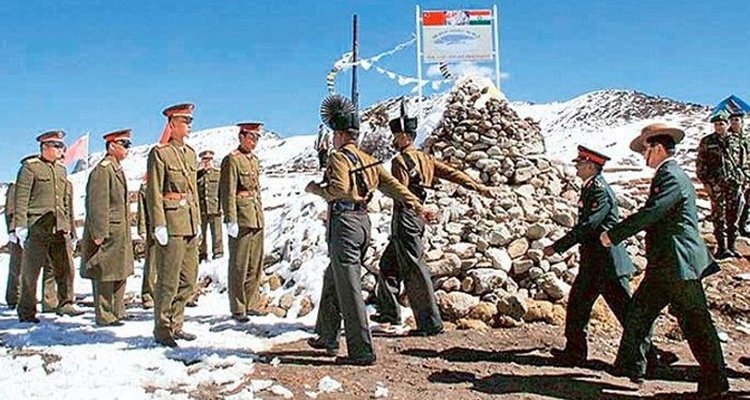
China and India have supposedly made diplomatic strides in resolving their border disputes. But this hasn’t stopped China from moving Tibetans “close to the Line of Actual Control” to strengthen its claim to the northeast Indian state of Arunachal Pradesh and perhaps prepare to cross the line just a little bit and then just a little bit more.
Researchers, a retired lieutenant general, and other Indians are justifiably suspicious (New India Abroad, October 24, 2026).
China is resettling Tibetans close to the Line of Actual Control (LAC) opposite Arunachal Pradesh to make the disputed boundary resemble an ordinary Chinese provincial frontier, with a long-term goal of pushing a “demographic invasion” into the Indian state over the coming decades, a report has warned….
Beijing is rapidly moving Tibetans into frontier settlements under its border-village and poverty-alleviation schemes, with figures cited by researchers showing that 241,835 people were involved in the Tibet Autonomous Region’s border-village programme. Other reports point to plans to shift tens of thousands of border residents into 628 villages, Lieutenant General (Retd.) Abhay Krishna, a former Army Commander of South Western, Eastern and Central Army Commands of the Indian Army, wrote in India Narrative….
The threat for India, wrote the defence expert, was not a sudden mass crossing of the LAC by Tibetan civilians but something far less visible.
“It is subtler, that is, a state-sponsored population architecture that entrenches Chinese control opposite Arunachal Pradesh compressing India’s strategic depth and making future incursions look like routine local administration”….
About 72 per cent of China’s “Xiaokang” border villages lie close to the LAC in India’s north-eastern sector, with 90 per cent of those facing Arunachal Pradesh, the report said, adding that the settlements double up as surveillance, communication and logistics hubs.
Bhutan, which shares a border with India as well as a border with China, is not mentioned in the NIA article. But those contemplating the CCP’s tactics may have China’s history of crossing into Bhutan in mind as well.
As of October 2024, the PRC had built some 22 villages or settlements, including military facilities, within Bhutan. Today, Bhutan and China are doing something called diplomacy about “the China-Bhutan Boundary Issue”—consisting mostly of issuing joint press releases heralding positive momentum—but not any kind of diplomacy that will lead to dismantling of the settlements.
Also see:
The Diplomat: “The Politics of China’s Land Appropriation in Bhutan” (October 15, 2024)
The New York Times: “Beijing Takes Its South China Sea Strategy to the Himalayas” (November 27, 2020)
“ ‘Each of us is a coordinate of the great motherland,’ a border guard was quoted as saying by an official state news agency, China Tibetan News.”