If you worked in Space Force as the very model of a modern major general, well acquainted with matters mathematical and equations simple and quadratical, you’d likely keep a record, partly graphical, of every CCP satellite and all its travels astronomical.
After recent space reporting, we are, in the lyric of Gilbert and Sullivan, “teeming with a lot o’ news.”
Defending the joint force
On the morning of September 14, 2026, Secretary of the Air Force Troy Meink made the “bombshell admission” that the U.S. has weapons in space. This fact made its way into the professional literature long ago but has never reached the broad public. “The United States now has on-orbit space control weapons capable of defending the joint force against hostile adversary action,” Meink explained.
Meink refused to provide details, but soon afterward a Space Force spokesman said: “Space control encapsulates the mission areas required to contest and control the space domain—employing kinetic and non-kinetic means to affect adversary capabilities through disruption, degradation and even destruction, if necessary. These capabilities can be employed for offensive and defensive purposes at the direction of combatant commands.”
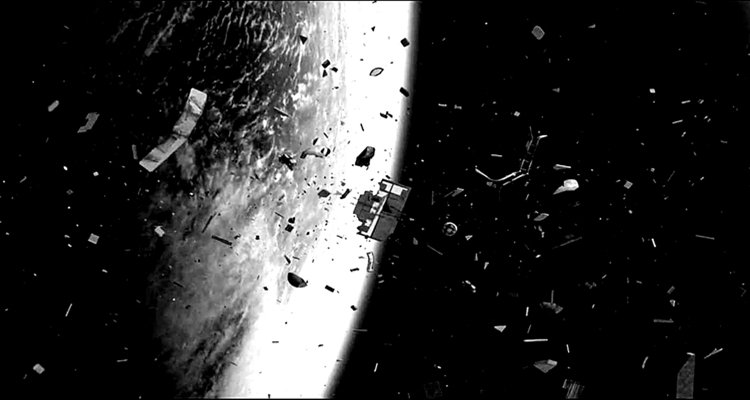
The Space Force disclosure came days after the news that Red China’s Yaogan-50 (02) satellite suffered some sort of tragedy while traveling in its retrograde orbit. From Gizmodo: “On September 4, the U.S. Space Force cataloged 43 debris objects from the breakup of Yaogan-50 (02), according to Jonathan McDowell, a former astrophysicist at the Harvard-Smithsonian Center for Astrophysics who tracks space activity…. It’s not clear what may have caused the Yaogan-50 (02) satellite to break apart, but it may have been a propulsion or battery failure, or it may have itself collided with another object or space debris.”
May have collided. Charming naïveté or an open mind?
Yaogan-50 (02) was in retrograde orbit, i.e., flying against the earth’s spin. This is unusual for non-photo-recon birds. Grokipedia: “In the context of space warfare, retrograde orbit satellites contribute to force multiplication” by taking much more detailed pictures with their synthetic aperture radar. “China’s exploration of retrograde monitoring satellites…underscores potential dual-use applications for inspection or disruption missions targeting geostationary assets.”
Yaogan-50 (02) was probably up to no good.
So far, our timeline looks like this:
September 8. Gizmodo relays the news that Space Force inventoried the detritus of Yaogan-50 (02).
September 12. The Wall Street Journal reports that “US officials have tied high-resolution satellite images supplied by Chinese entities to an Iranian missile strike that killed three American soldiers in Jordan in July.”
September 14. The Secretary of the Air Force announces that “space control weapons capable of defending the joint force against hostile adversary action.” In the next day or days, a Space Force spokesman refers to “employing kinetic and non-kinetic means to affect adversary capabilities through disruption, degradation and even destruction, if necessary.” Even destruction.
Three soldiers dead. Did we “defend the joint force against [further] hostile adversary action” by employing “kinetic means”? Was Yaogan-50 (02) an instrument of attack?
A harder target?
Now let’s go back to a story from March 2026.
“A [Red] Chinese–built surveillance satellite secretly transferred to Iran’s Revolutionary Guard enabled precision strikes on American military bases across the Middle East, injuring over 400 U.S. troops while Beijing and Tehran evade accountability.
“Iran’s IRGC gained control of Chinese commercial satellite TEE-01B in late 2024, using it to monitor and target U.S. bases in Saudi Arabia, Jordan, Bahrain, and Iraq….
“The Islamic Revolutionary Guard Corps Aerospace Force acquired operational control of the TEE-01B satellite in late 2024, transforming what Beijing marketed as a civilian Earth observation platform into a military surveillance tool.” At the same time, “The IRGC gained direct access to Chinese ground control stations for real-time data processing, eliminating Iran’s historical reliance on inferior domestic radar systems.”
This satellite “captured images of Prince Sultan Air Base in Saudi Arabia on March 13, 14 and 15,” according to the Financial Times.
Oddly enough, TEE-01B is still flying, whereas Yaogan-50 (02) met with misadventure or worse.
Note the communist charade around TEE-01B: packaged as a commercial product with commercial ground station support and all in the hands of a regime (Iran) which is supposedly doing its own targeting.
Even if they are or were, this would not have precluded Beijing from feeding additional targeting data from its own sources to Iran. Perhaps that’s what Yaogan-50 (02) was doing. Perhaps that’s how it met its end. Perhaps TEE-01B was out of Space Force’s easy reach, whereas Yaogan-50 (02), on a similar mission, was a more accessible target.
Meink’s statement is actually specific. “The United States now has on-orbit space control weapons capable of defending the joint force against hostile adversary action.” Defending the joint force. These are earthbound forces: Army, Navy, Air Force, etc.
If our modern military major general has a ledger filled with CCP satellite locations and other data, as is likely, then somewhere in March or April a space war policy may have been enacted and put that data to use. □
James Roth works for a major defense contractor in Virginia.