Was Tung Chee-hwa, who died on September 8, 2026 at age 89, a great person? In addition to being the chief executive of Hong Kong from 1997 to 2005, he was also a shipping magnate. Perhaps one could examine his career in shipping and other aspects of his life and find much to applaud.
But there’s no getting around the fact that, per Reuters, six years into his tenure ruling the former British colony, “Tung sought to push through Article 23. The proposed security law, covering offences like treason and sedition while expanding police powers, was widely seen as Chinese encroachment on Hong Kongers’ freedoms. It triggered a half-million-strong protest, with many demonstrators wearing black as a sign of mourning.
“Tung backed down. But the events of 2003 set the stage for increased tensions between opposition democrats and Beijing over the city’s future.”
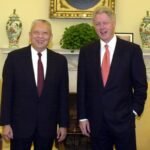
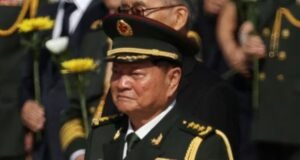
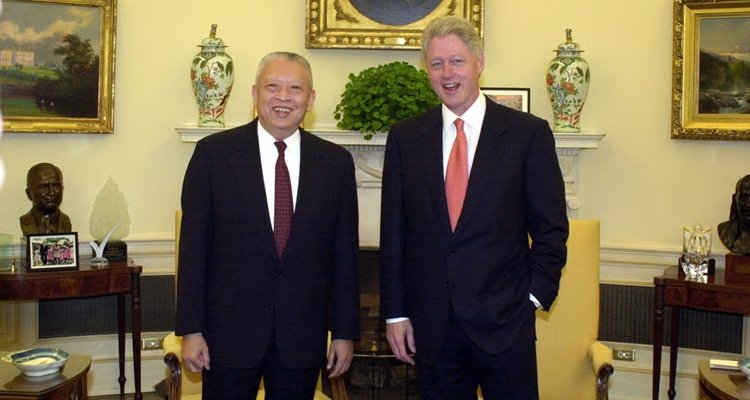
He did not repent. In 2019, Tung (shown above with a former U.S. president) attacked the prodemocracy protests of that year, saying that they endangered national security. A couple of years later, he hailed the demise of electoral competition in Hong Kong. We noted the persistence of his hostility to the rights of Hongkongers a couple of weeks ago in these pages.
Friend of the Party
But what advocates of liberty and individual rights regard as sins, the current Hong Kong government regards as virtues (The Associated Press, September 20, 2026).
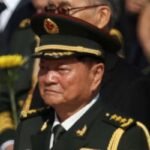
Chinese officials from Beijing joined Hong Kong political leaders for the service in what was the third state funeral in the former British colony since the 1997 handover….
Visiting official Shi Taifeng, a member of the Politburo of the ruling Communist Party, referred to Tung in a eulogy as a close friend of the party and a renowned patriot, according to China’s official Xinhua News Agency.
He said that Tung was an outstanding contributor to the one-country, two-systems framework that governs Hong Kong and nearby Macao, a former Portuguese colony returned to China in 1999….
[In 2003], an estimated half a million people took to the streets to protest the government’s plan to enact an anti-treason law that was seen as a threat to civil liberties. The government shelved the plan, and Tung resigned in 2005, citing health reasons.
The 2003 protest marked the start of years of pro-democracy protests that came to a head in 2019 and were followed by a crackdown and a Beijing-imposed national security law in 2020.
So Tung’s legacy is ships and the destruction of political freedom in Hong Kong. He didn’t do it all by himself, but he led the way and, when no longer in power, cheered from the sidelines.
The state funeral had been preceded by an endless feature article in South China Morning Post, all about “Humble leader and role model for a generation,” consisting of tributes to Tung.
Contributors said that his character endures…that he served with dedication…forged the one country, two systems framework…worked to maintain rule of law and judicial independence…helped ensure Hong Kong’s smooth return to China…gave his all in selfless service…promoted cooperation between Hong Kong and mainland…strengthened ties between the United States and Hong Kong…was a gentleman in the Confucian tradition who never badmouthed anyone…exhibited deep commitment to developing education sector…was tireless…was exemplary…was visionary…was a true political leader…taught the importance of humility…put people first…treated others with utmost sincerity, tolerance, and benevolence…planned Hong Kong development through both regional and national lenses…was kindhearted…always led by virtue…was a mentor…was meticulous and thorough…was warm, approachable, and visionary…was a role model for a generation…was a close friend of the Communist Party of China.
A nice guy, a great man, and a great friend of the Chinese Communist Party and its goal of subjugating the people of Hong Kong.