ISW works overtime to be objective and unemotional in its syntheses of what is known about violent acts and the context in which they occur.
This immunizing of account can be taken too far. For example, if the degree of certainty is 110 percent that the PRC ship rammed the other ship in the South China Sea in yet another repetition of a very familiar pattern of belligerence, is it really objective to imply doubt about which vessel did the ramming and which got rammed? Especially when the authors’ own concluding statement implies that they themselves have no doubt?
Here’s how the item in the China & Taiwan Update published by the Institute for the Study of War starts: “A China Coast Guard ship may have deliberately rammed a Philippine fisheries ship while trying to stop a Philippine resupply mission in the Spratly Islands” (September 22, 2026). May have.
Could…could
Here’s how the item ends: “The PRC could believe that continually blocking and harassing Philippine ships could eventually force the Philippines to ‘cede ground’ in the South China Sea.” (This is a weaker form of a statement made earlier in the piece: “The PRC likely views blocking resupply missions as an effective way to remove Philippine vessels from PRC-claimed waters.” “Probably” has been demoted to “possibly.”)
The tentativeness of this concluding statement doesn’t seem warranted either. What is the alternative and incompatible motive that the authors would propose? But notice what the statement takes for granted, that the ships of an agency of the People’s Republic of China habitually assault Philippine ships in the region, are “continually blocking and harassing Philippine ships.” Do the authors have any reason whatever to wonder whether the incident they are reporting on now is an exception?
ISW reports:
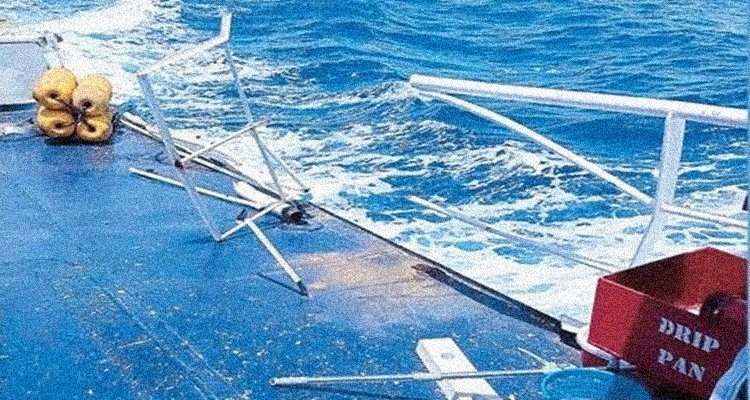
CCG ship 21585 (also known as Sanzhou’ao) collided with BRP Datu Magat Salamat, a Philippine Bureau of Fisheries and Aquatic Resources (BFAR) ship, on September 18 near the disputed Spratly Islands. The incident occurred in the waters between Sabina Shoal and Bombay Shoal, 54 nautical miles from the Philippine island of Palawan, while Datu Magat Salamat was conducting a resupply mission to Philippine fishermen. The Philippine Coast Guard (PCG) accused the CCG of deliberately ramming Datu Magat Salamat, while the CCG and PRC Ministry of Foreign Affairs claimed the Philippine ship “provoked” the CCG and caused the collision by abruptly cutting in front of the CCG ship. Both sides released videos of the collision. The PCG also reported that a CCG plane monitored Datu Magat Salamat on September 17, when the ship accidentally ran aground at another Spratly Islands atoll, Half-Moon Shoal, and had to be towed off. Ship-tracking data from Starboard Maritime Intelligence shows a CCG vessel patrolling near Half-Moon Shoal around the same time.
The PRC often tries to disrupt Philippine resupply missions in the South China Sea to prevent the Philippines from maintaining a long-term presence in PRC-claimed disputed waters. Sabina Shoal, Bombay Shoal, and Half-Moon Shoal are all within the Philippines’ exclusive economic zone (EEZ) and are classified as “low-tide elevations,” meaning they are not permanently above water and cannot be claimed by another country. The PRC claims them as its territory, however, along with nearly all of the South China Sea, and uses the CCG, PLAN [PLA Navy], and Chinese Maritime Militia to enforce its claims.
Did the China Coast Guard ship ram the Philippine ship? Yes. Was the CCG ship the aggressor? Yes.
Also see:
International Business Times: “China-Philippines Collision: What Happened to BRP Datu Magat Salamat in South China Sea?” (September 18, 2026)
“The Philippine Coast Guard says that the China Coast Guard vessel CCG-21585 passed around the back of the BRP Datu Magat Salamat at around 11.04 a.m. [on September 18] and got within about 10 metres of its stern. The PCG stated that at about 11:13 a.m. CCG-21585 carried out the manoeuvre once more and hit the BFAR vessel, which was keeping to its course. The Chinese ship then went round behind the Philippine ship again, being about five metres away.”
StoptheCCP.org: “The Spratly Rocks” (July 17, 2026)
StoptheCCP.org: “The Spratly Agenda” (February 1, 2024)