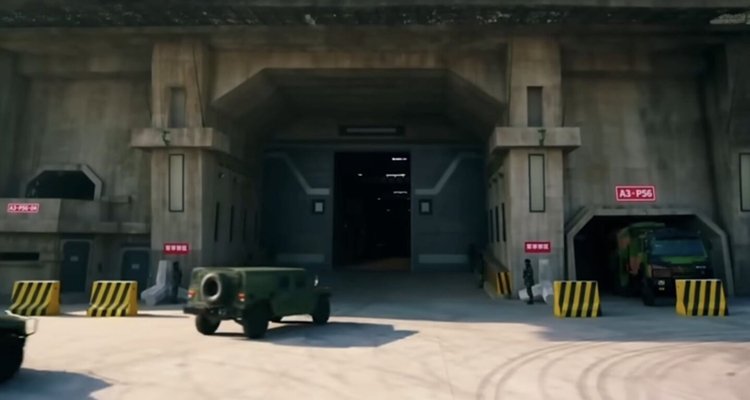
As the U.S. builds an underground shelter beneath a White House ballroom (to much criticism), Red China is finishing its new underground Military City in Beijing. At “1500 acres, it is ten times the size of the Pentagon.”
Was it the humorist P.J. O’Rourke who quipped that communists love concrete?
Boy, do they.
New Great Wall
In mid-September, Chinese state media “provided a rare look at the country’s underground military facilities, which form a vast network designed to protect strategic weapons, command structures, aircraft, ammunition and personnel from air and missile attacks.”
The reporting refers to “facilities” (plural). But this is one giant complex. It is called Red China’s Underground Great Wall.
“Underground” is not just for land forces. Earlier this year, YouTube brought us images of “an $800 billion underground naval base hidden deep beneath a massive coastal mountain. Buried beneath layers of solid rock, reinforced tunnels, secret dry docks, and heavily protected underground waterways, this hidden military megaproject creates one of the most mysterious naval facilities ever constructed.”
Then there are the air forces. As long ago as 2013, StrategyPage noted that although China “has the largest number” of underground airbases, about 40, “The U.S. would be using bases in the region that are not underground and sometimes do not even have concrete hangers for all aircraft.” Does it have protection for any?
Everyone can get into the act of detecting Red China’s fortifications. In early 2026, Google Earth sleuths discovered an “underground aviation shelter hidden in a mountain [and a] military airfield, next to which wide entrances into the mountain are visible. In addition to the two main entrances, numerous smaller entrances into the underground are scattered to the west. The similar style of the buildings suggests that they belong to the airfield. Together, they likely form a gigantic underground complex.”
In 2017, Stratfor reported that even the PLA base in Djibouti had a large below ground component, its “most impressive feature by far” being “a massive underground complex covering an estimated area of nearly 250,000 square feet.”
And on it goes. The communists are not building high-tech bastions. They’re building low-tech basics. This is common-sense survivability.
Iran
The Iran war goes some way towards justifying all the burrowing and cement mixing. Military.com reports that the U.S. and Israeli forces “repeatedly attacked entrances to Iran’s underground missile facilities. Satellite imagery later reviewed by CNN showed Iran had reopened at least 50 of 69 tunnel entrances examined across 18 missile bases, often using bulldozers, loaders and dump trucks to clear rubble and repair cratered roads.”
At least 50 of 69? Then the air attacks were rendered only minimally effective.
This raises the question as to whether, pre-Iran, the Pentagon regarded bomb-proofing as a waste of money given the capabilities of our Air Force, its missiles and munitions. Apparently bomb-proofing is not a waste.
Then there is the question of protecting civilian and military industry in this way.
“A 24-megawatt underwater data center off Shanghai entered full operation around May 2026, using seawater for cooling and offshore wind for power,” continues Military.com. “It has the capability to power around 20,000 homes. The project is commercial rather than military, but it reflects a broader willingness to move high-value infrastructure out of traditional aboveground facilities.”
United States
We ourselves are not protecting most of our surface military assets and certainly have no plans to protect any civilian sites, much less build underwater facilities.
Here’s a funny little item from 2019:
“As the House and Senate work to complete the DoD Appropriations and the National Defense Authorization Act, they need to prioritize resilience efforts not only at military installations, but the communities that surround them” (emphasis added). At least somebody was thinking about it.
Meanwhile, in 2026, here’s another war that the CCP is watching: “Russian missile and drone strikes on Oct. 14 damaged more than 25 power facilities and left roughly 600,000 people without electricity, according to Ukrainian officials.” If there were any Ukrainian bases nearby, they lost power too.
And here’s another funny item, this one from last year, reporting calculations that “the amount of concrete used by China to improve the resilience of its air base network could pave a four-lane highway from Washington, D.C. to Chicago.”
Meanwhile, “Since the early 2010s, the U.S. military has added only two hardened shelters and 41 non-hardened ones at airfields within 1,000 nautical miles of the Taiwan Strait and outside of South Korea.”
We have an adversary routinely hardening sites and digging underground. Setting aside the Cheyenne and Raven Rock mountain complexes, some missile silos, and the bunker under the ballroom, we don’t seem interested in following suit, not even after the catastrophic destruction of our facilities in the Iran war.
We have a Congress that can allot money. We have a U.S. Army Corps of Engineers that can build things. Surely they could both lend a hand in this matter. □
James Roth works for a major defense contractor in Virginia.