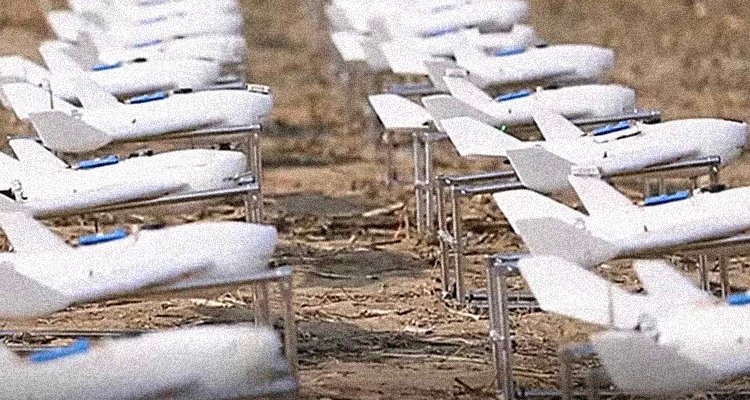
A funny headline on the DroneXL website talks about how the “PLA Demos 200-Drone Swarm Controlled by Single Soldier” is “Revealing the Pentagon’s Worst Nightmare.”
The author thinks that the nightmare is Red China’s outpacing the U.S. in swarm tactics.
True enough. But to many of America’s general officers, the idea of an offensive 200-drone swarm being controlled by even a full colonel—much less by a mere humble soldier—would be a “worst nightmare” indeed.
The problem is cultural, and militaries cannot transcend their own cultures.
The author explains, “Controlling a swarm from a single screen typically means the operator functions as a mission commander supervising highly automated processes [and is] not piloting in any traditional sense. The soldier sets objectives and monitors status. The algorithms handle flight paths, collision avoidance, and task distribution.”
Every part of this rubs against a general-officer culture that is risk averse and that micromanages in accordance with a zero-defects performance standard. Secretary of War Pete Hegseth is working to fix this, but changing a culture is a mighty undertaking. Meanwhile, the incentive structure remains the same.
Cultures
To a general officer, turning a soldier loose with 200 flying bombs would be the definition of career suicide. The same leadership that does not trust servicemen with pistol or rifle ammunition for sentry duty is not soon going to issue them hundreds of flying explosives.
Of course, on the communist side, there are bound to be cultural controls too. This is the Chinese Communist Party’s army, after all. And in such staged events as the one reported by DroneXL, we cannot see the hidden hand of the Party and how it will control (or at least authorize) its 200-drone soldier.
But the CCP is offense-minded, at least.
The story about the 200 drones describes an attacking communist swarm. Our author suggests that we compare this swarming exercise “to the U.S. approach. In October 2023, the military opened its Joint Counter-Small UAS [unmanned aircraft system] University at Fort Sill, Oklahoma, training approximately 1,000 service members annually in defensive operations. China’s competition trains multiples of that number in offensive drone development: building autonomous weapons, coordinating swarm attacks, and developing strike platforms.”
Note the difference. The U.S. builds a center that trains to defend, Red China builds one that trains to attack.
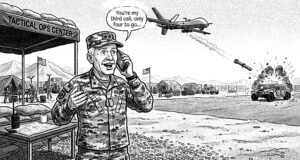
Meanwhile, the U.S. Army has shut down its one offensive drone unit, the Unmanned Assault Battalion.
Defense hits the political easy button. It involves low-risk, safe choices like jamming frequencies, firing lasers or anti-aircraft guns, and spoofing.
But even such passive electronic warfare can be a source of worry to our generals and admirals, for, “As with all military operations, the use of electronic warfare capabilities during an armed conflict must comply with the law of armed conflict….
“When an EMS [electromagnetic spectrum] operation qualifies as an attack, it must be directed at legitimate military targets and the incidental harm it is expected to inflict upon civilians and civilian objects must not be out of proportion to the anticipated military advantage. Thus, whether an EMS operation amounts to an attack is a critical threshold question that must be answered before assessing its legality.”
JAGs
That means bringing in the lawyers for every planned drone or anti-drone operation.
Do you recall the rules of engagement in Iraq and Afghanistan? Can a 200-drone attack, some drones acting autonomously, conform to rules of engagement?
We have not yet spoken of the U.S. military’s pervasive legal culture. Every commander has a military lawyer (branch, Judge Advocate General), and these JAGs advise the commander about the legality of an action. They are graduated from civilian law schools, they have a civilian mindset, and they are inducted without previous military experience. Commanders at every level defer to them almost automatically.
The restrictive rules of engagement are developed as a kind of convenient shorthand by which higher command encapsulates, in a rule set, the legal advice that it expects it would receive during combat. Commanders are thereby supposedly spared from having to consult JAGs—although, as we saw in Iraq and Afghanistan, the consultations continue even when the rules are in place.
The commander can also layer in additional restrictions based on considerations like winning hearts and minds.
The rules of engagement were tight in Afghanistan even before the arrival of General Stanley McChrystal, who further tightened them. He was replaced by General David Petraeus, who tightened them still more. This is the past but it is also the future.
So it is no surprise when the U.S. Chief of Naval Operations, quoting Admiral Samuel Paparo, says that “we cannot overlearn the lessons coming out of Ukraine and the Middle East.” They do not mean that we cannot study them enough; they mean that we must not study them enough.
And this mentality has spread to NATO, where Finland’s top strategist says, “I’m quite tired of drones.”
You’ll be even more tired when the swarms come. □
James Roth works for a major defense contractor in Virginia.