Dismal criticism of criticism of the Chinese Communist Party and the Communist Party of the Philippines is the purpose of commentary by Rommel Banlaoi, “From coffins to conversations: Rebuilding Philippines-China friendship” (Manila Times, August 9, 2026).
Banlaoi writes that “amid efforts to reset ties between the Philippines and China, the discovery of five caskets scattered across Metro Manila with anti-Beijing and anti-Communist Party of the Philippines messages is a stark reminder of how political symbolism can be weaponized to inflame passions. Coffins signify death and finality,” in this case a desire to bury “perceived” enemies rather than to engage them.
Greedy
Per Streamline, the caskets bore messages “against the Chinese Communist Party” like “Chinese Communist Party Greedy! Salot [plague].” And “the casket deposited at the Welcome Rotonda prominently featured defaced photographs of Chinese President Xi Jinping, Chinese Foreign Minister Wang Yi, and Chinese Ambassador to the Philippines Huang Xilian.”
Banlaoi believes that such rhetoric “risks reducing a complex bilateral relationship into caricature” of a country that is after all a neighbor and trading partner. Instead of “deepening hostility,” we should foster “mutual understanding.”
Also: “Millions of Filipinos of Chinese descent have contributed to our society for centuries. To demonize China wholesale is to erase this shared history and jeopardize opportunities for cooperation.” Study these words if you would like to learn more about how to knock down a straw man.
Banlaoi’s indictment thus misrepresents the apparent focus of the casket-depositors’ attack, communist parties and especially the Chinese Communist Party. According to him, the renegades intended to express enmity against all aspects of China and the Chinese, not the CCP and its deeds in particular.
Cold War rhetoric
Philippine officials have remonstrated against the casket-distributing, which has presumably broken one or more laws. The Philippine Department of Foreign Affairs says: “This incident does not reflect either the Philippine government’s approach to diplomacy or the manner in which Filipinos traditionally express political dissent.”
Rommel Banlaoi seems to object to the act itself and also to the fact that the few words appended to the caskets amount to slogans, merely pointing people in a direction or serving as a reminder rather than constituting a full-bodied discussion. The protesters sinned by adopting the strategy of protesters and advertisers through the ages.
As we read on, though, we find that the Banlaoi’s indictment is much broader. It’s not just the protesters’ non-expository pronouncements and alleged conflation of the CCP with all of China and the Chinese people that dismay him.
“Since the Cold War, anti-communist propaganda has been a staple of Philippine politics. But to recycle these tropes today risks oversimplifying our challenges. The CPP’s relevance has waned, and the government has pursued peace initiatives alongside security measures.”
The CCP, it turns out, sometimes pretends to be nice. Especially when intended victims resist. Wow. Meanwhile, all the assaults and incursions continue.
“Instead of coffins, let us place bridges in our public imagination—bridges of dialogue, cultural exchange, and mutual respect. Instead of burying relationships, let us nurture them. The Philippines must choose dialogue over division, friendship over fear, and understanding over hostility.”
Friendship with whom?
The friendly CCP
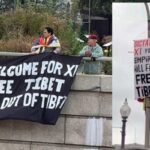
Domestic assaults on the rights of innocent persons by the Chinese Communist Party include mass surveillance and mass censorship; arbitrary detention, torture, and murder of dissidents and other innocent persons; denial of fair trials and due process; suppression of political opponents; preventing human rights lawyers from doing their jobs and punishing them for trying; outlawing independent journalism; repressing religious practice; destroying churches, synagogues, temples, statues; persecuting Falun Gong practitioners, Uyghurs, Tibetans, and members of other targeted groups; coercive ethnic and cultural assimilation; slave labor; mass detention and indoctrination, including by forcibly separating children from families in order to subject the children to boarding-school indoctrination; repressing protests; destroying the democracy and political freedoms of Hong Kong; coercive mass relocations; seizure of private businesses; eliminating academic freedom at home and trying to eliminate it abroad; arbitrary withholding of passports; murdering people in order to harvest their organs.
Trans-border assaults on the rights of innocent persons by the Chinese Communist Party include surveilling and harassing Chinese nationals living overseas; threatening to retaliate against their families; harassment of Philippine and other foreign vessels and their crews in the South China Sea and other waters; continuous military and other harassment of Taiwan; a threat to decapitate the prime minister of Japan; massive cyberattacks on governments and businesses around the world; pressuring the governments of foreign countries to cooperate in censoring speech and in detaining innocent Chinese nationals who have escaped the PRC.
The list is not exhaustive. None of it—except, in the most innocuous possible terms, “maritime disputes” in the West Philippine Sea—is mentioned by Rommel Banlaoi. I detect a risk of oversimplification.
Also see:
Marxists.org: “Constitution and Program: Communist Party of the Philippines 2016”
“The Communist Party of the Philippines is the revolutionary party of the working class in the Philippines and is the leading force of the Philippine revolution and the Filipino people. It learns basic principles from the teachings of Marx, Engels, Lenin, Stalin, Mao, Ho and other great communist thinkers and leaders….”