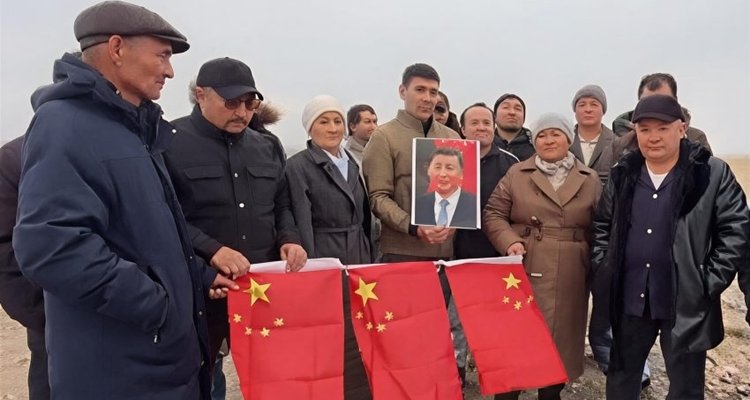
“Authorities in Kazakhstan have long misused the vague and overly broad offence of ‘inciting discord’ to suppress critical and dissenting voices, despite concerns from international human rights bodies,” says Yalkun Uluyol, a researcher with Human Rights Watch. “But this is the first time Kazakh authorities have imprisoned such a large group of activists” for advocating human rights in Xinjiang.
Last November, the 19 activists protested against conditions in Xinjiang and in particular against the treatment of a Kazakh truck driver who had been arrested and imprisoned in China. The goal was to march to the Chinese border. They were prevented from doing so by police and at first suffered only light punishment for peacefully protesting injustice (eurasianet, April 15, 2026).
But that wasn’t enough for China, which, apparently, is Kazakhstan’s boss.
Kazakh authorities initially charged the group with administrative violations and fined some and imprisoned others for a few days, but upgraded the charges to “inciting ethnic discord,” which carries a maximum sentence of 10 years, after Chinese diplomats expressed displeasure….
The Nagyz Atajurt activists, all ethnic Kazakhs who had resettled to Kazakhstan from Xinjiang Province, had done much to publicize the plight of the Kazakh minority in China, who along with Uighurs and Kyrgyz are subject to a campaign of repression, forced labor and reeducation by Beijing, according to UN reports. China denies mistreating Muslim ethnic minorities in Xinjiang….
Kazakh police stopped the group from approaching the border, so they decided to burn the flags and portrait [of Xi Jinping], Sherizat told Eurasianet in January. They also chanted slogans against the Chinese Communist Party and Xi….
Rights monitors describe the flag burning incident as legitimate political protest, adding that the act of burning a flag per se is not criminalized under Kazakh law.
Nine of the activists were sentenced to five years in prison. Eight were sentenced to five years or almost five years of “restricted liberty.” Two women in the group were sentenced to five years but got suspended sentences because they have young children to take care of.
The suspended sentences probably mean not that anyone in Kazakhstan who has tykes in tow can get away with any crime but that the judge understood that no crime had taken place—despite his willingness to imprison so many innocent people for committing this non-crime. Perhaps, then, he tempered his injustice with mercy to the extent that he felt he could get away with it.
“With this heavy-handed prosecution and punishment,” says Uluyol, “the Kazakh government has made it clear that it is only too willing to sacrifice the freedoms of its citizens in an apparent attempt to maintain increasingly cozy relations with Beijing.”