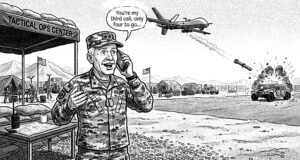
Dominant Narrative has weighed in, and the DM from DN is that the United States and Israel have “stumbled into a war without a plan. Iran is retaliating across the region. Oil prices are surging, and the world is facing another Middle Eastern quagmire. US senators have called it a blunder. Cable news has tallied the crises. Commentators have warned of a long war” (Al Jazeera, March 16, 2026).
One reason it’s a “quagmire” is that Operation Epic Fury and Operation Roaring Lion have already lasted longer than two weeks. As we know, most wars in world history were wrapped up very quickly. There was a six-day war in 1967, and in 1896 the Anglo-Zanzibar War lasted less than an hour. Etc.
The costs of the war in Iran are real, but “the critics are measuring the wrong things. They are cataloguing the price of the campaign while ignoring the strategic ledger.” What Muhanad Seloom, a professor of international politics and security at the Doha Institute for Graduate Studies, sees is
a recognisable military operation proceeding through identifiable phases against an adversary whose capacity to project power is collapsing in real time.
Iranian ballistic missile launches have fallen by more than 90 percent from 350 on February 28 to roughly 25 by March 14, according to publicly available data. Drone launches tell the same story: from more than 800 on Day 1 to about 75 on Day 15.
The figures drawn from US and Iranian military statements differ in detail but converge on the trajectory. Hundreds of Iranian missile launchers have been rendered inoperable. According to some reports, 80 percent of Iran’s capacity to strike Israel has been eliminated….
Much of the criticism of the US-Israeli campaign focuses on its costs while treating the status quo ante as if it were cost-free. It was not.
Iran entered 2026 with 440kg of uranium enriched to 60 percent purity—enough, if further enriched, for as many as 10 nuclear weapons. Before the June strikes, Tehran was less than two weeks away from enriching enough uranium for one nuclear bomb, according to US intelligence assessments. At that time, the International Atomic Energy Agency acknowledged that Iran’s accumulation of near-weapons-grade material had no clear civilian justification….
China, Tehran’s largest remaining economic partner, cannot receive Iranian crude while the strait is shut. Every day the blockade continues, Iran severs its own economic lifeline and alienates the one major power that has consistently shielded it at the United Nations. The closure does not just hurt the global economy; it accelerates Iran’s isolation.
Meanwhile, the naval assets Iran needs to sustain the blockade—fast-attack boats, drones, mines, shore-based antiship missiles—are being degraded daily. Its naval bases at Bandar Abbas and Chahbahar have been severely damaged…
The absence of a public diplomatic blueprint does not mean the military campaign is failing. It means the campaign is ahead of the diplomacy, a sequencing problem, not a strategic one. The military conditions for a durable settlement—Iranian missile capacity too degraded to rebuild quickly, nuclear infrastructure inaccessible, proxy networks fragmented—are being created right now….
Seventeen days in, Iran’s supreme leader is dead, his successor is reportedly wounded and every principal instrument of Iranian power projection—missiles, nuclear infrastructure, air defences, the navy, proxy command networks—has been degraded beyond near-term recovery. The campaign’s execution has been imperfect, its public communication poor and its post-conflict planning incomplete. War is never clean. But the strategy—the actual strategy, measured in degraded capabilities rather than cable news cycles—is working.
Does the war on Iran have anything to do with stopping the Chinese Communist Party? We’ve argued that it does.
Also see:
StoptheCCP.org: “Iran Is About China”