As announced by Premier Cho Jung-Tai, the ROC government is proposing a substantial increase in defense spending. If all goes well—keep this proviso in mind—it would go from what it has been over the past nine years, 2 percent to 2.5 percent of gross domestic product to, now, 3.32 percent of GDP (ROC Central News Agency, August 21, 2025).
Some of the proposed increase in the 2026 budget is a result of redetermining what counts as defense spending, i.e., does not represent an actual addition to defense spending. But it seems that even apart from the recalculation, spending on the Ministry of National Defense would increase by 20.1 percent.
Cho said the new calculation method followed North Atlantic Treaty Organization standards. “We are demonstrating to the world and to our own people our determination and capability to safeguard national sovereignty and security,” the premier said.
Under the same calculation, the proposed NT$949.5 billion [a little more than $31 billion in U.S. dollars], which still requires legislative approval, represents an increase of NT$176.8 billion, or a year-on-year rise of 22.9 percent, Hsieh Chi-hsien, head of the Comptroller Bureau at the Ministry of National Defense (MND), said at the briefing.
Even without taking into account veteran and Coast Guard expenses, the proposed budget for the MND alone will increase by NT$93.8 billion, a 20.1 percent rise compared with 2025….
Personnel costs, estimated at NT$200.8 billion, will remain the largest component of the MND’s 2026 budget.
The Lai government will not necessarily secure all of the defense spending that it proposes. The Legislative Yuan is dominated by the mainland-appeasing opposition, an alliance of Kuomintang lawmakers and Taiwan People’s Party lawmakers, which acted to cut or freeze some defense spending in the 2025 budget.
Moreover, a dramatic grassroots effort to recall many KMT lawmakers failed recently at the ballot box. The attempt and its defeat probably will not inspire opposition lawmakers to be more cooperative with the administration. (A second, smaller round of recall elections is being decided on August 23.)
10 percent?
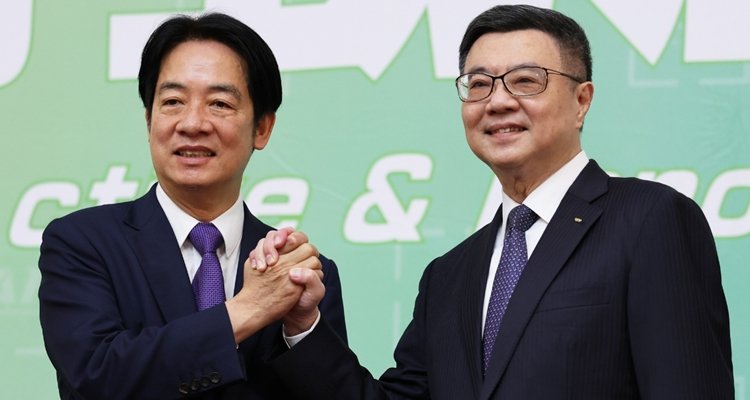
The U.S. president, Donald Trump, has called for the Republic of China to increase its defense spending to as much as 10 percent of its GDP. In March 2025, CNA quoted Cho Jung-tai (shown above, right, with President Lai Ching-te) as saying that the government “does not have the capacity” to do that.
Only 18.1 percent of the ROC’s proposed 2026 budget would go to national defense. Other broad components include 27.4 percent for “social welfare,” 18.3 percent for “education, science and culture,” and 14.1 percent for “economic development.” The Taipei Times says that these numbers come from the ROC’s Directorate-General of Budget, Accounting and Statistics via CNA.
Much of the explanation, then, for the problem getting to defense spending that is anything like 10 percent of GDP is the problem that all bloated welfare states have. Too much spending on things that have nothing to do with the proper function of government.
Also see:
Radio Free Asia: “Taiwan’s record budget cuts raise concerns over defense readiness” (January 22, 2025)