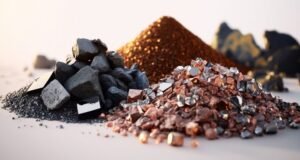
Science reporters often refer to resources on the moon but rarely say what those resources are.
As early as 2002, Chinese space scientist Ouyang Ziyuan was telling BBC News that the moon “could serve as a new and tremendous supplier of energy and resources for human beings.” The BBC did not manage to mine more details.
This from Time magazine last year is also typical: “The moon is believed to contain a source of waste-free nuclear energy that could meet global energy demands for 250 years.” Specific but not specific!
Just this August, the head of Russia’s Roscosmos announced that “the race for the development of the natural resources of the moon has begun.” No follow-up from the press. What resources?
A valiant trio
If we search the barren landscape long enough, we can at least unearth a NASA description of moon “resources.” The Jet Propulsion Lab lists three: water (in its ice form), helium-3, and lanthanides.
We long ago discovered water here on earth, and there seems to be a lot of it. No need to import more.
Helium-3 can be and is manufactured on this planet. Moonside extraction of it would require lots of complicated industrial machinery. As for lanthanides, ScienceNotes.org instructs us that on earth they “are not especially rare elements (despite being rare earths).” The problem is that they are difficult to separate from one another and from their ores. So we don’t need to go to the moon for them; and if we do, separating them there will require much equipment and expertise.
But this is NASA’s list. And too much of NASA’s publicity—for example, its announcement of a plan to put a woman on the moon by 2024—can’t be taken seriously. Their “resources” are unconvincing.
If China has brought back moon soil and rocks, perhaps they know better what the “resources” might be. But is China talking?
If the United States knows that China knows about the moon’s resources, but the United States does not itself know, this may explain the persistent vagueness we encounter when personages on the American side refer to “moon resources.” It may also explain the scale and tempo of China’s planned exploration of the moon.
China and the United States have set up rival consortiums to participate in their South Pole moon base projects and in space projects generally. The U.S. has its Artemis Accords, “a cooperation framework for the civil exploration of the moon, Mars and other astronomical bodies.” China has its International Lunar Research Station Cooperation Organization. Artemis has eight signatories. ILRSCO has twelve that are either on board or in negotiations. (UAE quit after joining and Russia seems to be on hold.)
Mostly peaceful
The press reports new signings. But it avoids details about the bilateral arrangements, including conditions and restrictions, details that could tell us whether the moon bases will have dual purposes, both military and peaceful, or a solely peaceful ones.
Consider the military purposes of a moon base. These can include tracking and interfering with earth-orbiting objects, bombardment of earth, domination of the moon installations belatedly installed by other countries after a particular country has established itself, and the occupation or control of strategic terrain.
The purportedly peaceful intentions of this proposal, if the proposal itself is real, stretch credulity.
Beijing may extend the planetary defence system it is constructing in China to the moon and beyond to protect the Earth from asteroid strikes that could potentially wipe out a city or human civilisation, according to scientists involved in the project.
Wu Weiren, chief designer of the Chinese Lunar Exploration Programme, said the new plan included putting three guardian satellites carrying lots of fuel and kinetic weapons into the moon’s orbit around the Earth.
That’s from 2022. Or try this report, from March 4, 2024:
China plans to establish all-seeing surveillance on the moon after drawing on the successes of the country’s massive video surveillance network, Skynet, for a system it says will ensure the security of its forthcoming lunar base. It said that if “abnormalities” were detected the system would “promptly generate alarm signals and initiate appropriate response measures”.
“Ensure the security” and “appropriate response measures.” Hmm.
Military uses seem more practicable and attainable and therefore more likely than peaceful uses. There is no way to carry “moon resources” in bulk to earth. There are no markets for “moon resources” shipped to earth that make financial sense. If resources exist at all, they would have to be extracted, processed, and used right up there on the moon, consuming much equipment, labor, and money without producing any profit.
When you compare the military plans with the purely civilian ones, the military ones seems better thought out, more practical, less speculative.
Spratly talk
The scientist Ouyang Ziyuan says that “whoever first conquers the moon will benefit first.” That’s Spratly talk.
For its part, the U.S. military “is investing in new technologies to build large structures on the lunar surface. It’s designing a spy satellite to orbit the moon. And it just announced plans for a surveillance network—what it calls a ‘highway patrol’—for the vast domain between Earth’s orbit and the moon, known as cislunar space.”
The military possibilities are not a new topic. The United States Army prepared quite an interesting 1959 plan for the construction of a U.S. Army moon base—an almost purely military case that is well worth reading.
This leads us to a final possibility, setup of a Chinese land grab before any resources have been discovered. The Chinese would take their position and exploit any advantage once opportunities appear.
This would require local military superiority. And the need for military superiority may explain much of China’s proposed moon program. □
James Roth works for a major defense contractor in Virginia.
Also see:
StopTheChinazis: “The Spratly Agenda”
”In one recent incident, the Chinese Coast Guard, sailing in Philippine waters, discovered Philippine fishermen collecting sea shells on Scarborough Shoal. Hundreds of miles from China’s coasts, China’s Coast Guard forced them to return the shells to the shoal and leave. The shells thus seem to be ‘Chinese property.’ In that sense, the air over the Spratlys is also ‘Chinese property’ and will eventually contain Chinese warplanes, sent to keep the surrounding waters Pinoy-free.”