The term “gray zone” is used to describe warlike conduct not yet intense and continuous enough to unambiguously constitute the conducting of a war. We’ll know real war when we see it.
Routinely and deliberately crowding, ramming, water-cannoning, and knifing the vessels and fishermen and navy men of a targeted country do not add up to war, supposedly. At least not until the future history of the war is written and historians explain how “the first phase of the war consisted of a decades-long period marked by China’s persistent harassment of the peaceful vessels of the Philippines and encroachment on its territory.”
At present, though, China’s treatment of the Philippines, like its treatment of the ROC, and of Japan, etc., is a gray area.
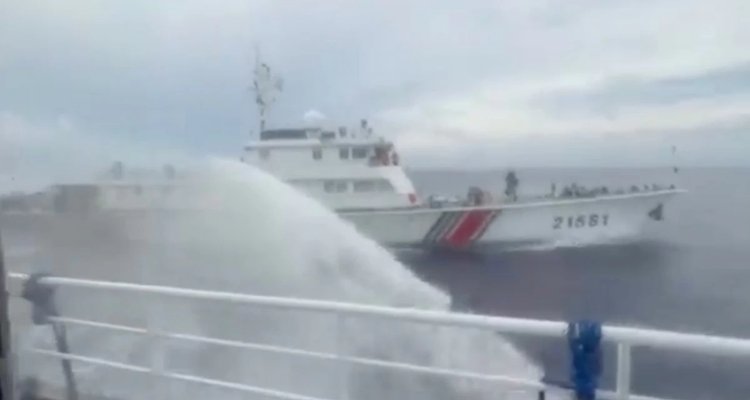
Water cannons
Things probably seem more black-and-white if you’re in the middle of things. For example, if you were one of the persons who were on the Philippine Coast Guard and Bureau of Fisheries and Aquatic Resources vessels while they were being attacked by China Coast Guard vessels a couple of days ago.
Manila Bulletin (July 24, 2026):
The Philippine Coast Guard condemned another series of dangerous actions by the China Coast Guard after several Philippine vessels were hit by water cannons while delivering assistance to Filipino fishermen near Bajo de Masinloc (Scarborough or Panatag) Shoal in the West Philippine Sea on Friday, July 24….
The first water cannon attack occurred at around 6:26 a.m. when a CCG vessel with bow number “3107” blasted BRP Cape San Agustin from about 400 meters away. The PCG vessel was conducting a maritime patrol about 15 nautical miles northeast of Bajo de Masinloc.
Before the attack, BRP Cape San Agustin was already being shadowed by at least six CCG vessels together with Chinese maritime militia boats, the PCG said.
Also hit by the water cannons of a China Coast Guard ship: BFAR vessel BRP Datu Paduhinog (three times, by China Coast Guard vessel 21581) and BFAR BRP Datu Cabaylo (by China Coast Guard vessel 3303).
At least one of the China Coast Guard ships, 21581, had shut off its Automatic Identification System transponder, which enables ships to be tracked and helps other ships to avoid collisions with them.
Blades and batons
Such encounters have led to injuries of Filipinos.
On June 17, 2024, the China Coast Guard “ ‘hijacked’ the Philippines’ rotation and reprovisioning (RORE) mission, resulting in damage and severe injury of a Navy officer, who lost his right thumb.” The China Coast Guard used bladed weapons to puncture rubber boats being used by the Philippine Navy. The Filipinos tried to fend them off using no weapons but “their bare hands,” perhaps concerned to avoid provoking phase two of the war.
According to Romeo Brawner, Jr., then chief of staff of the Armed Forces of the Philippines: “This was the first time we saw the CCG bringing in bolo sticks, spears, knives…. That’s what they used to destroy, to puncture our RHIB [rigid hull inflatable boat]. We saw it in the videos. We saw in the video how the Chinese even threatened our personnel by pointing their knives at our personnel.”
On July 20, 2026, somebody in a China Coast Guard boat bashed a Philippine navy man with a wooden baton when two Philippine boats tried to drive the CCG boat away from a grounded Philippine Navy vessel at Second Thomas Shoal.
ISW says that “PRC-Philippine hostilities in the South China Sea have escalated around the tenth anniversary of the 2016 arbitral ruling that found the PRC’s ‘historic claims’ in the sea to have no basis in international law.” This seems to be true. But by presenting in neutral tones each side’s summary of what they say happened on July 20, the ISW writers give the impression that it’s unclear which side was the aggressor. Not true.