Early in his second administration, President Trump issued an executive order to restrict birthright citizenship.
The president’s January 20, 2025 order states that it would now be U.S. policy “that no department or agency of the United States government shall issue documents recognizing United States citizenship, or accept documents issued by State, local, or other governments or authorities purporting to recognize United States citizenship, to persons: (1) when that person’s mother was unlawfully present in the United States and the person’s father was not a United States citizen or lawful permanent resident at the time of said person’s birth, or (2) when that person’s mother’s presence in the United States was lawful but temporary, and the person’s father was not a United States citizen or lawful permanent resident at the time of said person’s birth.”
The order doesn’t seem to deal with the case of a baby born in the U.S. to a surrogate mother who is herself lawfully present in the country while the father is a foreigner with no right to permanently reside here; a baby that, as in other cases, is quickly taken out of the country to grow up somewhere else.
6-3 ruling
Judges immediately blocked enforcement of the order, not because its remedy is incomplete but because it offers any remedy at all. And now the U.S. Supreme Court has ruled by a 6-3 majority that No, the U.S. is not allowed to protect itself in this way (SCOTUSblog, June 30, 2026).
Writing for the majority, [Justice John Roberts] emphasized that the “children born of parents unlawfully or temporarily present in the United States” “satisfy both elements of the Citizenship Clause.”
“Under the Constitution,” he concluded, “they are citizens at birth.”
In a dissenting opinion, Justice Samuel Alito called the ruling both “one of the most important decisions in the history of the Court” and “a serious mistake.” “Careful analysis of the text of the Fourteenth Amendment and the process that led to its adoption,” Alito argued, “shows that it does not degrade the concept of United States citizenship in this way. Instead,” he contended, “the Fourteenth Amendment confers citizenship on only those children who, at birth, owe allegiance solely to this country.”…
Justice Brett Kavanaugh agreed with the result that the court reached—that the president’s executive order is invalid—but not its reasoning. In his view, Trump’s order “does not violate the Fourteenth Amendment” but does violate a federal law providing that children who are “born in the United States, and subject to the jurisdiction thereof” are U.S. citizens. Congress, Kavanaugh suggested, “could amend” that law “or otherwise enact new legislation establishing exceptions to birthright citizenship for children born to foreign citizens unlawfully or temporarily in the country. But Congress has not yet done so.”
In his dissenting opinion, Justice Clarence Thomas wrote that a main purpose of the Fourteenth Amendment was to help formerly enslaved blacks. “Blacks were entitled to citizenship because they were Americans. They had no other homeland, owed no allegiance to any foreign power, and were subject to no other authority. The same could not be said for the children of foreign temporary visitors.”
Birth tourism
The Washington Times reports that President Trump
complained about the decision on social media and, in particular, suggested it was a boon for China.
“I would like to congratulate President Xi, and the Great Country of China, on their massive Birthright Citizenship WIN!” he wrote.
During oral argument in the case this spring, the Trump administration pointed to China’s “birth tourism,” where Chinese women come to the U.S. specifically to give birth. Those children enjoy automatic citizenship.
Companies have emerged to facilitate the births, charging tens of thousands of dollars to help the women obtain travel visas, house them while they’re here and even apply for government assistance programs to help offset the medical costs.
Birth tourism isn’t limited to China, though it’s a large player in the market. Globally, women usually return home with the children, who are raised far from the U.S.
Birth tourism poses a problem for national security, Justice Alito observed in his dissent. “Suppose the child [in the U.S. only long enough to be born here] never visited the United States while growing up and was inculcated with hatred of this country. According to the court, that person is a citizen of the United States. He can enter and leave the country as he pleases. He can travel the world on a United States passport. Even if he plots to harm this country, he cannot be deprived of his status as a citizen, at least under current precedent.”
President Trump’s executive order tried to deal with a problem that perhaps Congress will now tackle, though whether it can do so in a way that satisfies at least two of the six Supreme Court justices in the current majority, Kavanaugh plus somebody else, is unclear.
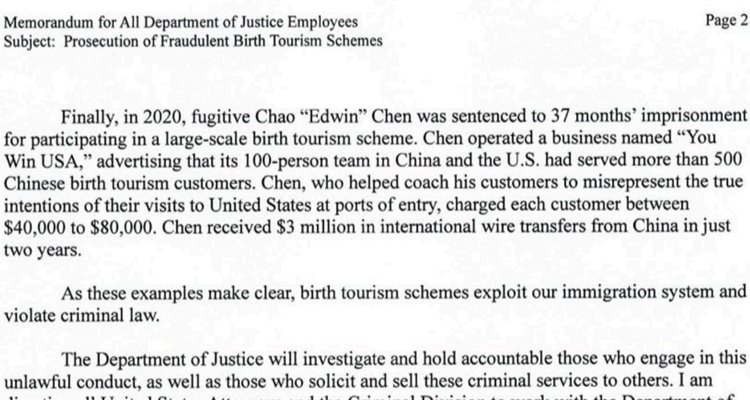
Meanwhile, the Justice Department’s Colin McDonald has issued a memo to employees stating “that people who come to the United States under ‘false pretenses’ to give birth and secure citizenship for their child could be criminally charged under laws barring visa fraud, money laundering, identity theft and wire fraud.”
Also see:
White House: “Protecting the Meaning and Value of American Citizenship” (January 20, 2025)
U.S. Department of Justice: “Memorandum for DOJ Employees on Prosecution of Fraudulent Birth Tourism Schemes from Assistant Attorney General Colin McDonald” (June 30, 2026)
StoptheCCP.org: “ ‘That’ll be 200 surrogate babies, please’ ”