Some developing stories don’t develop.
Take the stalled negotiations over the Republic of China’s special defense budget, which the Lai administration and DPP members in the legislature want to pass in its present form and many KMT members want to block or slash. The negotiations are still stuck “despite growing US pressure to pass the budget” (ISW China & Taiwan Update, May 1, 2026).
Taiwan’s Legislative Yuan has been gridlocked for months over competing versions of a special defense budget bill to fund asymmetric capabilities. Negotiations between the legislative caucuses of Taiwan’s ruling Democratic Progressive Party, the opposition Kuomintang, and the opposition Taiwan People’s Party on April 23 and April 27 both ended without a consensus on the core procurement items and total funding amount….
US officials have intensified efforts to lobby Taiwan to pass the asymmetric defense special budget… [The deadlock in the Legislative Yuan] has already delayed Taiwan’s payment for the High Mobility Artillery Rocket Systems, a key system in that arms package. All special budget versions include funding for that arms package, but the special budget from the Cabinet and DPP also includes 20.2 billion USD for future US arms purchases and 9.5 billion USD for Taiwanese domestic arms manufacturing, totaling nearly 40 billion USD. The KMT and TPP bills allocate around 12 billion USD….
Disagreement within the Kuomintang could break the deadlock if KMT members who are uncomfortable with the low-spending KMT budget and are currently suggesting a middle ground were ultimately to side with the DPP and carry others with them. I don’t know whether that’s a realistic possibility. But:
A faction within the KMT, represented by legislator Hsu Chiao-hsin, is advocating for a special budget of around 25 billion USD…. KMT Deputy Chairman Chi Lin-lien harshly criticized LY Speaker Han Kuo-yu, a KMT member, for allegedly supporting Hsu’s proposal over the party caucus’s bill. KMT Chairwoman Cheng Li-wun appeared to try to ease party tensions and said the LY would not approve funding for future US arms sales without formal letters of offer from the United States, regardless of the amount. Cheng also stated that passing the Cabinet’s 40 billion USD budget was “absolutely impossible.” The KMT and TPP proposals do not cover Taiwanese domestic manufacturing of drones and air defense systems, which are likely to be critical to Taiwan’s defense.
Which is better, under-protecting Taiwan from the People’s Liberation Army or overprotecting it?
Government spending can be wasteful. Concerns about waste or procedural laxity are often reasonable. But are these the kind of considerations most fundamentally motivating KMT chairwoman Cheng, who declares passage of the $40 billion budget, the only version being proposed that would fund domestic development of air defense and drones, to be “impossible”?
Dangerously defensive
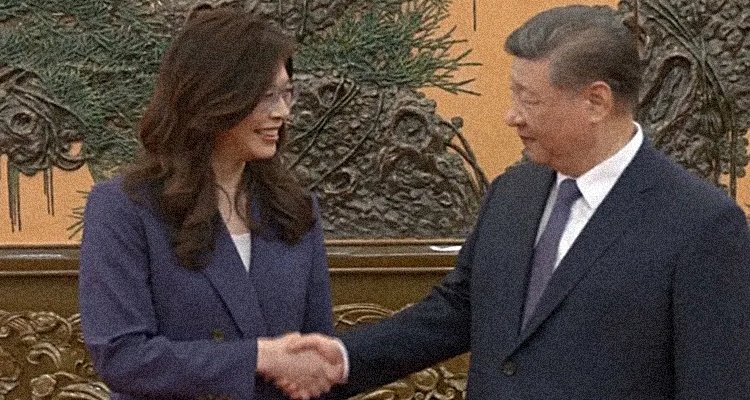
Cheng’s public comments give the impression of someone who regards enhancing the defense of Taiwan as counterproductive and even dangerous if it disturbs the peace-at-any-price diplomacy at which she has become so adept.
According to ISW, the PRC “aims to portray DPP efforts to bolster Taiwan’s self-defense as a major obstacle to cross-strait dialogue, in contrast with KMT policy. [A CCP] spokesperson stated on April 22 that Taiwanese President William Lai Ching-te’s efforts to increase societal resilience and implement more realistic combat exercises constituted ‘seek[ing] independence through force,’ the ‘root cause’ of cross-strait instability.”
Cheng says that DPP’s proposed defense spending not only treats Taiwan “like an ATM” but is “playing with fire.” The DDP is turning Taiwan into a “powder keg.” The better defended Taiwan is from the bullies across the strait, the more vulnerable.
Also see:
Asia Society: Positioning the KMT in the U.S.–China–Taiwan Triangle: Cheng Li-wun’s Early Tenure