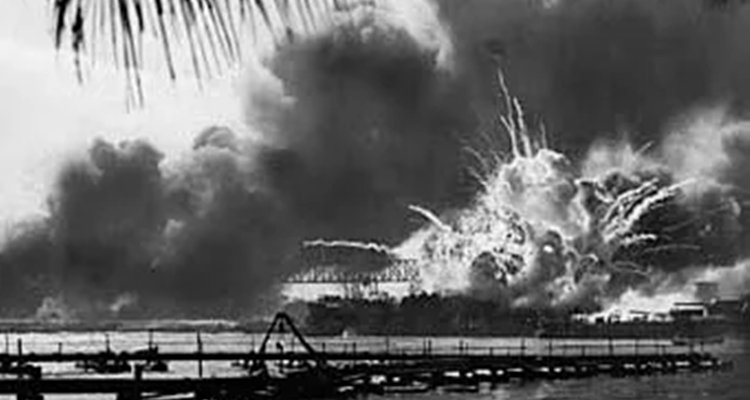
The Pearl Harbor attack was a twin disaster because ten hours after the Hawaii blitz, Japan wiped out half of the Army Air Force in the Philippines at Clark Field and fighter base Iba.
That this double disaster had been possible was regarded as an outrageous command failure then and was widely known to the following generation of officers. It should be taught in service schools today…but apparently it is not, because American aircraft are being caught on the ground, again.
Clark Field II
In the Middle East recently, “2,000 air, missile and drone strikes…hit at least 20 American facilities across eight countries”—damaging or destroying 42 aircraft, wiping out a naval base in Bahrain, and wounding or killing almost 900 servicemen.
No generals have been relieved over this. The Department of War missed a good opportunity to set a performance standard.
At least one publication has sounded the alarm: “The US depends heavily on major bases in Japan, Guam, and elsewhere to sustain military operations in the Indo-Pacific. Those installations will become easy targets at the start of any war with [Red] China. Plus, [Red] China possesses a far greater and more sophisticated missile and drone arsenal than does Iran.”
In fact, “Many of those facilities, as we have seen in the Iran War, are poorly defended.”
The Cato Institute, generally more concerned with economic than with military matters, has also noticed a problem.
“In the Indo-Pacific, where roughly 80,000 U.S. soldiers are forward deployed on about two dozen large bases—many [are] at similar distances from [Red] China as the Middle East bases are from Iran. [Red] China’s missile arsenal is probably similar in size to Iran’s pre-war stock (about 3,000 missiles) but much more diverse and sophisticated. Space-based targeting will also make it more accurate…. U.S. bases in South Korea and the First Island Chain are so vulnerable that they are a source of crisis instability: [Red] China has an incentive to strike first in a crisis before US forces scramble from their bases to attack.”
Note this fascinating point: offering “a source of crisis instability” by tempting a Clark Field II strike.
The…solutions
Citing retired generals like Ben Hodges (Army) and Glen VanHerck (Air Force), a Times op-ed proposes some solutions.
(1) Consolidate bases to save money and expose fewer servicemen.
But if you are consolidating bases you are making more lucrative targets.
(2) Place facilities underground.
They might be safe from drones but not from hypersonic missiles, bunker busting bombs or tactical nukes.
(3) Build decoys to draw fire.
But the first wave of attacks would take out all the decoys. And nowadays who thinks that decoys can fool satellite-based hyperspectral and multispectral imaging?
With general officers offering advice like this, no wonder the U.S. Central Command asked its troops to offer suggestions on how to defeat Iran.
Speaking of hypersonic missiles, which the U.S. has yet to deploy, it appears that Iran’s maneuverable Castle Breaker hypersonic weapon played a large role in destroying America’s bases. “It can easily reach U.S. and allied targets across the Middle East, including in Israel—and major American bases like Al Udeid Air Base in Qatar, Prince Sultan Air Base in Saudi Arabia and the Al Dhafra Air Base in the United Arab Emirates.”
Good news for America, though: “The U.S. Navy has released video showing its Blackbeard hypersonic missile mounted under the wings of an F/A-18E/F Super Hornet during flight testing, confirming that the program has moved beyond ground integration and test-loading” (emphasis added).
The Defense News adds that the Navy “is targeting at least limited early operational capability by 2028.” Well, 2028 is just around the corner, isn’t it? And the Army is just a little farther behind: “The U.S. Army is also developing a ground-launched Blackbeard variant.”
Once our Army, Navy and Air Force develop, build and deploy hypersonic systems, they will have a starting point in learning how to counter them. Maybe that will come by 2038.
Must fix
Meanwhile, “The Air Force is developing a new enlisted job specialty to defend bases against missile and drone attacks. Alarming damage to air bases across the Middle East during Operation Epic Fury focused leaders’ attention on the requirement.”
So that’s what it took to get the attention of the generals.
“Air base defense in the Pacific, where bases in Japan are well within reach of China’s long-range weapons, continues to vex Air Force planners. The military’s primary missile interceptor systems, such as Patriot, belong to the Army, and while the Army ostensibly is responsible for protecting Air Force bases from attack, there aren’t enough systems to go around.”
A few early warning signs are worth noting.
July 11, 2024. The Mitchell Institute for Aerospace Studies published a paper discussing how “over the past 30 years, Air Force air base defenses, especially in the Western Pacific, have atrophied due to a lack of resources and funding.”
January 7, 2025. The Hudson Institute published “Concrete Sky: Air Base Hardening in the Western Pacific.” The report surmised that U.S. airfields “face a threat of severe [communist] Chinese military attack. People’s Liberation Army strike forces of aircraft, ground-based missile launchers, surface and subsurface vessels, and special forces can attack US aircraft and their supporting systems at airfields globally.”
June 1 2025. Ukraine launched operation Spiderweb, its drones achieving a Clark Field result against Russia’s strategic bombers. U.S. planners noticed but took no action in regard to its Middle East dispositions.
June 3, 2025. Rand published a study “Assessing Progress on Air Base Defense.” Spoiler alert: “improvements to date have been limited, though the threat has advanced substantially.”
We have suffered several Clark Field events in the war with Iran. And now we seem ready to take even more punishment in any war with Red China. The Department of War needs to fix this. □
James Roth works for a major defense contractor in Virginia.