Imagine a land where 60% of underground water, 30% of rivers and 19% of cultivated soil are so polluted as to be dangerous to human beings. This is communist China.
Saving villages
In places where the situation gets bad enough, the government comes in, bulldozes a village, and forcibly relocates the inhabitants. If the situation is tolerable by the government’s low standards, the village or town is left alone.
When cancer rates spike, the locals are able to correlate the high rates of cancer with high pollution.
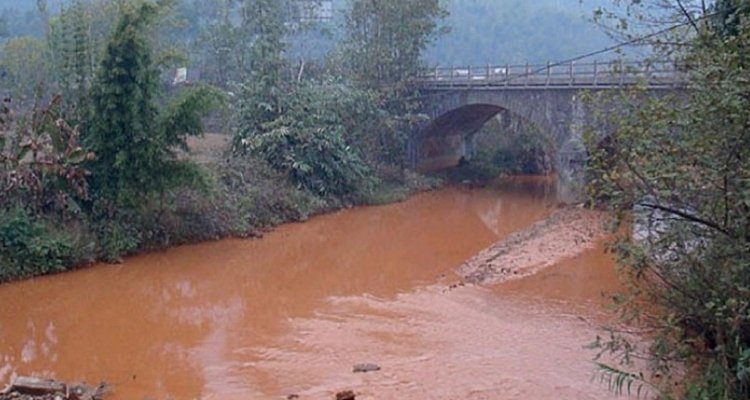
Huangmengying is one of the 459 “cancer villages” in the country. “Since 1992, more than 140 out of 2,800 people in this region died of cancer,” says Huo Daishan, an ecologist trying to raise awareness about this issue. “This street is called the ‘cancer alley’ because each house holds at least one victim.”
[Inhabitants] of Huangmengying fall ill because of the river’s pollution. “The water they are drinking comes from the well filled by this river. They’re eating fish caught in this same river and the vegetables are irrigated by the same water,” he says.
Cancer statistics are stale, perhaps because the government stopped counting (or publicizing the counts). But it is reported that throughout China, cancer rates “rose 196% between 1973 to 2004.”
Cancer is the new leading cause of death in China as cancer mortality rates have risen 80% over the past 30 years. Toxic air and smog is the primary suspect in cities and large urban areas whereas polluted water is suspected to be the leading cause of cancer in rural areas. According to government reports, more than 70% of China’s rivers and lakes are polluted.
That was written in 2020, seven years after the environment ministry used the term “cancer villages” in a report. Quote, “There are even some serious cases of health and social problems like the emergence of cancer villages in individual regions.” This slip of the typewriter was treated as a government admission and ignited waves of news stories about these “cancer villages.”
Also in 2013, New Scientist reported that cancer now accounted “for 25 per cent of deaths in cities and 21 per cent in rural areas” of China.
In 2020, Chen Wanqing, deputy of China’s national cancer registry, asserted that the admission was a mistake and that the environment ministry had been reprimanded. “During a meeting between health and environmental officials, they renounced the wording of the [environment ministry’s] report. They sent instructions to provincial officials urging them to restrict usage of the term ‘cancer villages,’ claiming ‘The statement was not correct, or not appropriate.’ ”
And that was the end of that term in official texts.
Hard trade-offs
To understand the industrial incentive to pollute and the government’s complicity, consider, first, that “local governments face hard trade-offs between long-term sustainability and short-term needs to provide employment and support public services. As a result, environmental regulations are largely overlooked with the acquiescence of locals.”
Second, that the central government imposes growth targets on local governments, prioritizes manufacturing as the premier economic activity, and depends on local government to fund social services.
A 2020 book on Chinese “Cancer Villages” says that after China’s economy began developing more rapidly after the late 1970s, “Local governments, under pressure to increase GDP (gross domestic product) and driven by their own interests, allied themselves with enterprises, making it hard for ordinary people affected by pollution to fight back.”
But “the acquiescence of locals” cannot actually be taken for granted.
In Huangmengying, “Wei Dongying, often called China’s Erin Brockovich, started investigating the deaths of her neighbors in the early 1990s.”
In the village of Qingpuling in Fujian province, where the Fujian Solid Waste Disposal Company incinerates medical waste, blanketing the surrounding area, 394 residents hired some lawyers and sued the plant owners.
In 2022, in Liaoning province, near the city of Huludao, residents signed “a mass petition urging the government to address the region’s chemical industry.” Using their own names. Needless to say, in Red China “publicly speaking out against the government, or government-mandated policies, can result in imprisonment, arrest, or worse.”
Whether there is civic action or not, the government seems to know that it has a problem. In 2013 it admitted that it was producing and that people were “consuming” harmful chemicals. Also that “toxic chemicals have caused many environmental emergencies linked to water and air pollution.”
Better data
Nowadays, the communists see pollution as a major issue that needs to be addressed. They have removed caps from pollution fines. They have closed some factories. They have permitted some “environmentalism” from NGOs.
But is it all just image-burnishing? If the incentive structures that rewarded these abuses remain in place, what serious improvements can we expect?
Given enough top-down scrutiny, one thing is certain: different levels of the government will tamper with the data so as to reduce the heat coming from the Beijing. Better data, fake or real, will count as progress.
Continued civic action and expressions of public discontent will paint a more realistic picture. □
James Roth works for a major defense contractor in Virginia.