In World War II, Germany and Japan used blitzkrieg, lightning war, to conquer fast and hard. The momentum could not be sustained, in part because Europeans and the rest of the world could no longer con themselves about what was happening as many had done during the lead-up to open war. In contrast, the modern People’s Republic of China has adopted the strategy of slowkrieg.
Slowkrieg can take place over years and decades. It has cyber fronts, propaganda fronts, geographic fronts. Massive things happen, but not yet the final step of bombing and troops moving in full-scale war, although there may be skirmishes along borders and between ships.
Island outposts
In a recent post, StoptheCCP.org publisher Paul Jacob noted that although dictator Xi Jinping reportedly promised then-President Barack Obama in 2016 that the PRC would not militarize the islands of the South China Sea, Xi did not regard this pledge as sacred.
By 2019, General Joseph Dunford, was saying: “President Xi Jinping promised President Obama that they would not militarise the islands. So what we see today are 10,000 foot runways, ammunition storage facilities, routine deployment of missile defence capabilities, aviation capabilities, and so forth. So clearly, they have walked away from that commitment.”
What commitment? It was a lie.
The general advised “coherent collective action…. They need to be held accountable in some way so that future violations are deterred.” This advice has been only inconsistently adopted.
Paul also noted that “the PRC now boasts 10,000 Chinese soldiers on 27 illegal military outposts.” According to 19fortyfive.com:
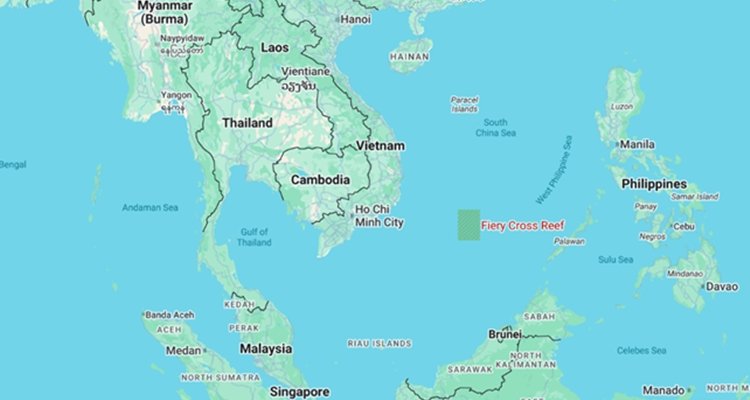
China’s artificial islands in the South China Sea aren’t just military infrastructure—they’re permanently staffed military nodes housing between 5,000 and 10,000 troops across 27 outposts. The “Big Three” bases at Fiery Cross Reef, Subi Reef, and Mischief Reef host aviation units, missile batteries, and radar installations capable of supporting more than 70 fighter aircraft and extending Chinese air power 800-plus miles from the mainland.
China’s artificial islands, best known for runways capable of supporting fighter and bomber operations, also house between 5,000 and 10,000 troops. Spread across 27 outposts, these thousands of military personnel mean the islands aren’t just infrastructure but permanently staffed military nodes.
The biggest concentration of troops is at the “Big Three” bases: Fiery Cross Reef, Subi Reef, and Mischief Reef. With the largest garrisons, these bases host aviation units, missile batteries, and radar installations.
In August 2025, Naval News reported that satellite imagery analyzed by the Asia Maritime Transparency Initiative was showing “new and enhanced radar facilities, antenna fields and reinforced electronic warfare installations at the ‘big-three’ Chinese outposts—Mischief, Subi and Fiery Cross reefs.”
Taiwan and Japan
On May 25, 2026, Reuters reported that “Taiwan sent ships and fighter jets to monitor the second Chinese ‘joint combat readiness patrol’ in a week near the island, in what a senior Taiwanese security official said showed China was the sole source of instability in the region.”
China has pressured Taiwan by increasing its military presence around the island, and Taipei is on high alert for further Chinese actions after President Xi Jinping discussed Taiwan with U.S. President Donald Trump in Beijing this month….
Taiwan’s defence ministry said it had detected 21 Chinese aircraft, including J-16 fighters and drones, operating all around the island, which, along with warships, were carrying out a “joint combat readiness patrol.”
Is there an extra-high alert? The Republic of China military always has to be on high alert about the military of the People’s Republic of China, because the PRC is always threatening the ROC. It’s not all-out war, not yet. Just a long-drawn-out slowkrieg marked by ever-greater encroachment and line-crossing.
Monkton refers us to a clamorous X post by Unveiled China, relaying the suggestion of Palmer Luckey, “founder of Anduril Industries, the autonomous weapons powerhouse building tech for the U.S. military,” that if the PRC goes to war, Taiwan would be “merely the opening move.”
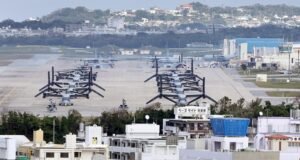
Xi Jinping has personally targeted the Ryukyu Islands, the Japanese chain including Okinawa that sits between Japan and Taiwan, by citing 650-year-old archives claiming they were a Chinese tributary state. [Luckey:] “He’s not saying this because he loves wandering the national archives. They are constructing a national narrative that would allow them to convince their people to start with Taiwan and end with a lot of our Pacific allies.”
Chinese state media and academic journals are already actively questioning Japan’s sovereignty over Okinawa.
It’s slow until it’s fast.
Also see:
The Japan Times: “Ryukyu sovereignty question simmers in China” (May 16, 2013)
“The questioning of Japanese sovereignty over the Ryukyu Islands, including Okinawa, by Chinese scholars appears to reflect a new Beijing approach toward antagonistic foreign governments.”
The Asahi Shimbun: “Tamaki visits China after Xi’s remarks on past ties to Okinawa” (July 5, 2023)
“ ‘Since I was in Fuzhou [as a senior city official], I have known that the city had deep interactions with the Ryukyus because the facility that housed the Ryukyus’ diplomatic and trade mission as well as a graveyard for people from the Ryukyus are there,’ Xi said.
“A Chinese media outlet subsequently ran a special feature emphasizing that the Ryukyu Kingdom was once part of China’s sphere of influence.
“A diplomatic source in Beijing said such a Chinese reaction is a political message to Japan that China could raise the issue of Japan’s sovereignty over Okinawa if the country becomes overly committed to Taiwan.”