As the United States military focuses on the war with Iran, Mike Pompeo warns us that the People’s Republic of China still is what it is: “the defining threat of our time” (which may mean roughly the same thing as the more arcane-sounding “pacing threat”).
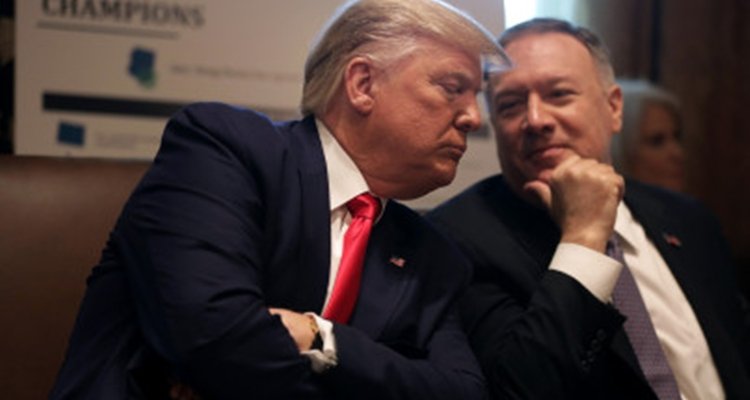
If anything, suggests the former secretary of state (shown above with the president), the necessity of dealing with China is even “more urgent” in the current circumstances. “When America’s attention is elsewhere,” the Chinese Communist Party moves (American Center for Law and Justice, April 24, 2026).
Look at what’s happening right now in the East China Sea. Beijing has quietly reserved an enormous block of offshore airspace—larger than Taiwan itself—for a 40-day period. These NOTAMs [notices to airmen] run from the Yellow Sea down toward Japan, locking out traffic from the surface to unlimited altitude. Forty days. No explanation. No propaganda. Just silence….
This is a sustained operational posture—the kind you maintain when you’re practicing real-world contingencies. Blockade tactics. Airspace control. The precise maneuvers you’d need if you were serious about Taiwan or wanted to test [U.S.] commitments to Japan.
The timing is deliberate. Beijing watched the United States and Israel take the fight to Iran and made a calculation: Now is the time to push. They’re not subtle about it—they just count on us being too distracted to notice. They’ve been doing this for 30 years….
The CCP is betting we’re too stretched, too distracted, or too timid to hold the line. They’ve made that bet before and been wrong. Let’s make sure they’re wrong again.
Analyses of the consequences for the PRC of the war on Iran seem mostly to fall into two camps. One says China is net benefiting. The other says China is net losing. Pompeo seems to be saying maybe yes, maybe no—depending on what the U.S. does. “Beijing is moving. We need to move faster.”
Iran has been a scourge of China’s adversaries that for decades China has helped to equip—with aircraft, arms, drones, missiles, missile components, fuel precursors, satellite-based navigation that beats GPS—and otherwise, e.g., by thwarting sanctions against Iran in the United Nations. Eliminating Iran as a threat, which I hope is the consequence of the present war, must also weaken China. But we’re not all the way there yet.