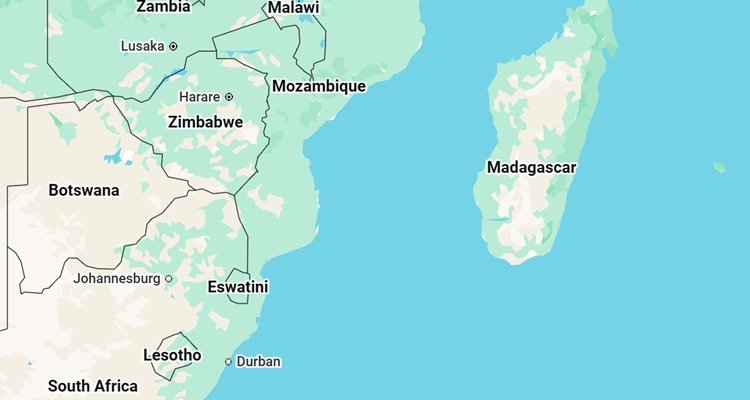
Confirming that it would be inviting disaster for the United Kingdom to turn over the Chagos islands, one of which contains an important UK military base, to Mauritius, on Tuesday Mauritius joined two other African nations to deny overflight permission to a plane scheduled to take ROC President Lai Ching-te to Eswatini. (Because of opposition within the UK and pivotally by the United States, the Starmer administration’s efforts to transfer the Chagos islands are currently stalled.)
Eswatini is one of only a dozen countries, and the only country on the African continent, to formally recognize the Republic of China.
In refusing to let Lai enter their skies, the Seychelles, Mauritius, and Madagascar were acting under pressure from the People’s Republic of China.
Responses
The U.S. Senate Foreign Relations Committee has said on the social media platform X that blocking Lai’s plane “is a disturbing breach of civil aviation norms. The U.S. should not let China normalize this—and should be clear-eyed about our relations with countries that so quickly bend to its pressure.”
Congressman Tom Tiffany wrote to Secretary of State Marco Rubio about the matter, arguing for a freeze on foreign aid recently promised to Madagascar. He “also urged Washington to consider placing Mauritius on a ‘travel ban’ list, saying that the country has long sought to push the UK out of the strategically important Chagos archipelago.”
A committee in the ROC’s Legislative Yuan passed a motion with “cross-party backing” to condemn China’s strong-arming of Mauritius et al.
However: “Opposition Kuomintang (KMT) Legislator Hsu Chiao-hsin said she had no objection to the substance of the motion and supported the president’s right to visit diplomatic allies, but she raised procedural concerns,” namely “that officials from the Ministry of Foreign Affairs were not present to provide input on the motion’s wording, as is typically the case. DPP lawmaker Lin Chu-yin responded that the proposal was stating a position rather than issuing an administrative directive, and was intended to express lawmakers’ stance against what she described as China’s ‘bullying.’ ”
The immediate reaction of the Taiwan People’s Party and the Kuomintang is also instructive.
The TTP “strongly protested and condemned” mainland China’s actions, which “seriously trample on our sovereignty and interfere in our internal affairs.” However: “If the CCP continues to ‘aggressively constrict Taiwan’s diplomatic space and intimidate the Taiwanese people,’ it will only exacerbate tensions in the Taiwan Strait and push the Taiwanese people farther away, the TPP said.” The implication being that it would be a bad thing for the Taiwanese to become less susceptible to CCP blandishments.
The Kuomintang called the blocking of Lai’s trip to Eswatini “deeply regrettable.” One KMT official, Yin Nai-ching, stressed that the cancellation of his trip “was ‘not connected’ to the meeting earlier this month in Beijing between KMT Chairwoman Cheng Li-wun and Chinese leader Xi Jinping.”