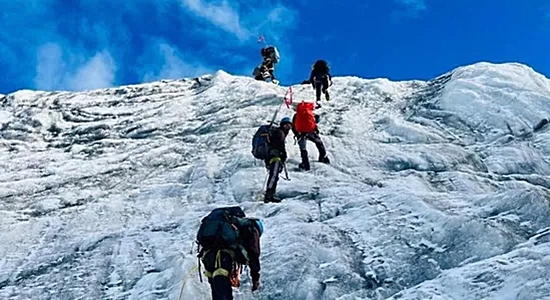
In the Arunachal Pradesh region of northern India, one of the many “disputed territories” of other countries that China cartographically adds to its own territory, a 15-member team of mountaineers led by Colonel Ranveer Singh Jamwal has climbed a previously uncharted mountain and named it after a Tibetan spiritual leader, Tsangyang Gyatso, who died in 1706.
The new name of the mountain peak is Tsangyang Gyatso Peak.
Kalpit Mankikar, a student of China with the Observer Research Foundation in New Delhi, observes that among the apparent motives for the climb and name conferral was the desire to resist China. “China has been renaming places in Arunachal Pradesh with [Chinese] names, and this has led to calls within India for similar actions” (“Indian mountaineers name peak claimed by China after Dalai Lama,” Radio Free Asia, October 2, 2024).
The naming of the peak follows Beijing’s assignation of Chinese names to 30 locations controlled by India in Arunachal Pradesh earlier this year—a move swiftly dismissed by New Delhi.
It was the fourth time since 2017 that China had issued place names for geographical areas in what it calls “Zangnan,” or southern Tibet, within Chinese territory…
When asked about the naming of the peak at a regular press conference in Beijing on Sept. 26, Chinese Foreign Ministry spokesman Lin Jian said he wasn’t aware of the matter.
But he went on to claim that “Zangnan” is part of China, and said it was “illegal and null and void for India to set up the so-called ‘Arunachal Pradesh’ in Chinese territory.”
Jigmey Choenyi, president of the Bharatiya Janata Party minority Association of Lumlha District of Tawang, said there is no cause for concern that Beijing would object to or interfere in the peak’s naming.
“Tawang is part of India, and the peak is located well within Indian territory, not in China or, to be more specific, Tibet,” he said.
These kinds of gestures and assertions and counter-gestures and counter-assertions may seem meaningless in comparison to physical military threats and whatever hardware, training, and strategy and tactics are required to resist such threats. But psychological warfare and propaganda also have their effects, including on morale and how determined people are to prepare and put to good use the more tangible elements of self-defense.