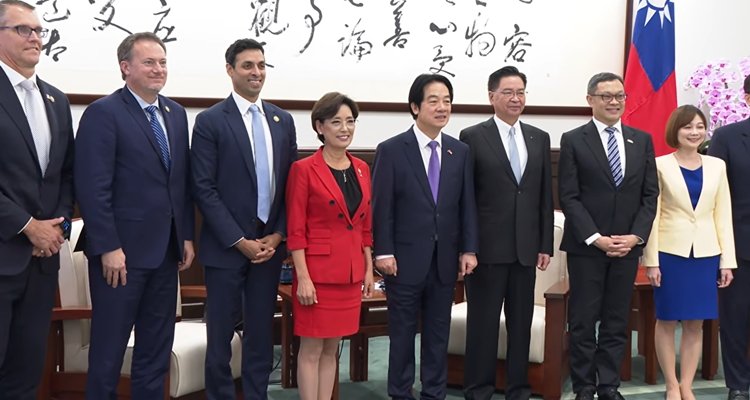
In Taipei, Republic of China President Lai Ching-te recently met with a U.S. congressional delegation led by Representative Young Kim, who chairs the Subcommittee on East Asia and the Pacific (Gov.tw, July 31, 2026).
They had public statements to make.
Lai: “This year marks the 250th anniversary of the founding of the US and the 30th anniversary of Taiwan’s first direct presidential election. Both of these democratic milestones remind us that freedom and democracy, in Taiwan and throughout the world, were hard-earned and must be safeguarded by generation after generation….
“Today, China continues to intensify military pressure on Taiwan and ramp up gray-zone aggression. Our stance has always been clear: we will neither provoke nor act rashly. Nor will we yield or back down. We will staunchly maintain the status quo of peace and stability across the Taiwan Strait. Peace is achieved through strength. We are committed to further increasing Taiwan’s defense budget and bolstering whole-of-society defense resilience.”
Kim: “Our bipartisan delegation represents California, Virginia, Iowa, and Texas, and each of us is blessed to represent states with robust and growing economic and cultural ties with Taiwan. By traveling together, our goal is to show how congressional support for Taiwan is bipartisan and strong. We believe a secure and free Taiwan is critical for the security in the Indo-Pacific and for the United States.
“We’re here to face down the threat from the Chinese Communist Party, and the path forward is daunting, but we can overcome this challenge together. The more concrete steps that Taiwan takes, the more the United States can do to support Taiwan. Deterrence takes two to tango, so help us help you.”
Presumably, the “help us help you” line was aimed at those who have sought to block the ROC government’s defense initiatives and not at those like President Lai and others who have been proposing them.
Coast guards
Diplomatic action was paralleled by military action, also on July 31, as the China Coast Guard patrolled waters to the east of Taiwan, “angering Taipei, which condemned the move as a political operation aimed at expanding Beijing’s control.”
The China Coast Guard says that it will keep doing what it’s doing. It’s just trying to “effectively ensure orderly navigation and activities,” in the words of a CCG spokesman.
The ROC Coast Guard responded by sending ships to monitor the CCG ships and accusing Beijing of “fake law enforcement, real expansion of power.”
China had begun the patrols in June to express its displeasure with diplomatic meetings between the Philippines and Japan to discuss maritime boundaries.