U.S. Senator Tom Cotton is urging the Department of Justice to “investigate communist China influence on data center development” (June 10, 2026).
“Alarming reports indicate that a network of foreign actors, led by the Chinese Communist Party, is attempting to manipulate U.S. policy and public opinion on data centers,” says Cotton in a letter to the acting attorney general.
“Maintaining America’s AI advantage is vital to American economic strength, diplomacy, national security, and military power. Americans certainly have valid concerns about potential rising energy costs and strains on natural resources related to data centers, and we should implement common sense regulations and legislation to protect communities from adverse effects. But we can’t allow any effort by foreign adversaries to [exploit] these fears and undermine our technological development.”
Three collaborators
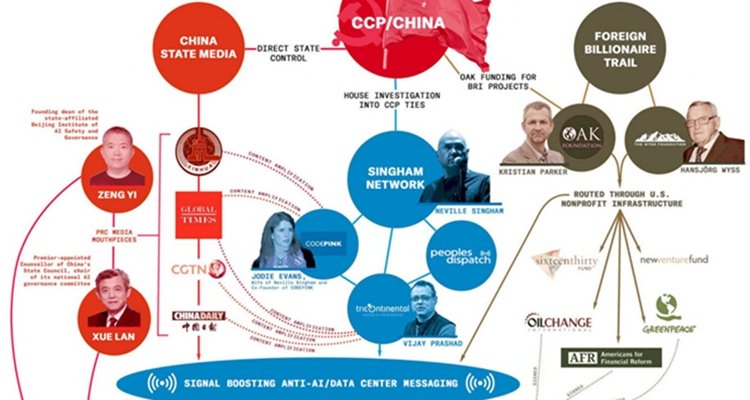
Cotton relies in part on research by the Bitcoin Policy Institute published May 18, 2026 on “three vectors of foreign influence—CCP state media, the Singham network and foreign-billionaire dark money” behind a campaign to impede development of AI in the United States.
The author, Sam Lyman, doesn’t start off well, suggesting that “there may come a time when the United States and China must engage in bilateral negotiations to ensure safe AI development” right after noting that discussions about AI safety “should not be influenced by geopolitical rivals, especially China, which aims to accelerate AI development ‘to gain the initiative in global science and technology competition.’ ” The U.S. can safely engage in discussions with mainland China about “safe development of AI” some time after the Chinese Communist Party is dead and buried, assuming that any such discussions with a foreign government would ever be advisable.
The BPI report discusses:
Foreign state media. Beijing’s English-language outlets—CGTN, China Daily, and Global Times—together with Russia’s RT have run attributed campaigns directly targeting US AI data centers and US export controls while the Chinese state simultaneously subsidizes its own AI buildout.
The CCP-aligned Singham network. A US 501(c)(3) ecosystem funded by Shanghai-based US expatriate Neville Roy Singham, who is currently under congressional inquiry for his reported ties to the CCP, has openly collaborated with China’s official state media organs and spent nearly five years producing parallel domestic content opposing US AI infrastructure, AI labs, and AI export controls.
Foreign-billionaire funding. Multiple foreign-tied charitable vehicles, including those of Swiss billionaire Hansjörg Wyss and British billionaire Alan Parker’s Oak Foundation, have funneled more than $2 billion into US 501(c)(3) and 501(c)(4) advocacy infrastructure. A significant portion of that money now flows directly into the organizations driving the anti-data-center campaign.
The real AI choice
The result, so far, of all the activity that Lyman outlines is a congressional bill, the Sanders–Ocasio-Cortez AI Data Center Moratorium Act; “at least 54 local data-center moratoriums have already passed in US towns and counties, with another nine under active consideration”; and statewide moratorium bills “filed in at least 12 more states this legislative cycle.”
Lyman argues that the choice policymakers face is not between AI and no AI but between American AI and Chinese AI. “The Bitcoin Policy Institute has spent the last two years arguing that American leadership in computing infrastructure…is a bedrock condition of US economic and national security.”