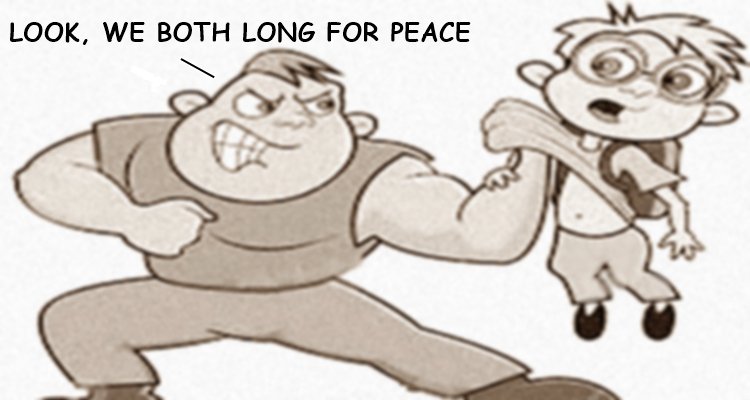
The long-awaited meeting between the two party chairpersons took place Friday in Beijing. It had been prepped by many lamentable public words by Cheng Li-wun, leader of the Kuomintang, intended to soothe Chinese Communist Party sensibilities. At the meeting, Xi Jinping, leader of the self-describedly peaceful CCP, pressed for peace (The New York Times, April 10, 2026).
As wars rage and American alliances look less certain, China’s leader Xi Jinping is making a renewed case to Taiwan: Its future lies not with Washington, but with Beijing.
Mr. Xi delivered that message implicitly in a rare meeting in Beijing on Friday with Cheng Li-wun, the chairwoman of the Nationalist Party, Taiwan’s main opposition party….
Beijing shuns Taiwan’s governing Democratic Progressive Party, which rejects Beijing’s claim that Taiwan is its territory. But China maintains ties with the Nationalist Party, which favors closer ties with Beijing.
“The world today is far from tranquil, and peace is all the more precious,” Mr. Xi told Ms. Cheng at the opening of their talks, according to a Taiwanese television broadcast of the meeting. “Compatriots on both sides of the strait are Chinese, one family, and the desire for peace, development, exchanges and cooperation is a shared aspiration.”
Positivity
Did Cheng make clear that the Republic of China would never voluntarily agree to be subjugated by the mainland; which is what the CCP, which has never ruled out conquering Taiwan by force, belligerently demands? No.
In her remarks, Ms. Cheng also appealed to a shared Chinese heritage, and to the idea that Taiwan could benefit from Mr. Xi’s policies, which he calls the “great rejuvenation of the Chinese nation.”
“General Secretary Xi very clearly conveyed a very positive message, and then he showed a great deal of care and attention for the expectations and needs of Taiwan,” Ms. Cheng told reporters at a news conference in Beijing afterward, using Mr. Xi’s title as leader of the Chinese Communist Party. In her public remarks, she did not mention the regular harassment of Taiwan by China’s armed forces….
The Taiwanese government’s Mainland Affairs Council, which manages relations with Beijing, denounced Ms. Cheng’s comments to Mr. Xi, saying that they undermined the island-democracy’s separate status. Ms. Cheng’s “proclaimed ‘framework for peace’ is a ‘framework for unification’,” the council said….
“If Cheng Li-wun wants Taiwanese people to clearly feel she has accomplished something in her trip, the fastest way would be reducing Chinese military activity against Taiwan,” said Professor Tzeng [Wei-feng Tzeng, of National Chengchi University in Taipei]. “But that is unlikely because she doesn’t have the chips to negotiate this with Xi Jinping. She’s an opposition leader after all.”
Tzeng’s criticism is misleading insofar as it implies that if Cheng did have the chips required to negotiate a reduction in Chinese military harassment of Taiwan—which should be stopped altogether, not merely “reduced”—she would have played those chips. But all her words are those of a person unwaveringly committed to appeasement.
The threat
CNBC notes Xi’s repetition of the often-repeated contention that “ ‘Taiwan independence’ is the primary threat undermining stability across the Taiwan Strait.”
Taiwan News reports that Chuang Jui-hsiung, a caucus leader of the Democratic Progressive Party, the ROC’s ruling party, stressed that contrary to statements by Cheng, “the vast majority of Taiwanese do not believe that accepting ‘one country, two systems’ or the 1992 Consensus would allow them to control their destiny.
“DPP legislator Fan Yun added that a Mainland Affairs Council poll in late March found 81% opposed one country, two systems, while 70% supported the special defense budget [proposed by the DPP and opposed by the KMT]. She accused Cheng of packaging a minority view as mainstream opinion, calling her a ‘master of public opinion fraud.’ ”
Another Taipei Times story explains that the so-called 1992 Consensus “refers to a tacit understanding between the KMT and CCP that both sides of the Strait acknowledge there is ‘one China,’ with each side having its own interpretation of what ‘China’ means.” (That each side is allowed its own interpretation of what “China” means is obviously not how Xi interprets the Consensus, however.)
Former Mainland Affairs Council chairman Su Chi in 2006 admitted that he made up the term to break a cross-strait deadlock and alleviate tension.
China would continue to promote cross-strait economic cooperation and enable all Chinese people, including people in Taiwan, to live better lives, Song said.
Song criticized supporters of Taiwanese independence, calling on people in Taiwan to “stand on the right side of history.”
Nothing says “living better lives” better than being subjected to unremitting military harassment, cyberattacks, hostile and gaslighting propaganda, and other assaults, all provoked by a sentiment no more severe than wanting to be left alone.
Also see:
News CN: “General Secretary Xi Jinping met with Kuomintang Chairperson Cheng Li-wen” (Google Translated)
Reporting on Xi’s comments during the meeting with Cheng:
“The mainland and Taiwan belong to one and the same China; China is the shared homeland of the Chinese nation. The fundamental prerequisite for compatriots on both sides to effectively safeguard and build this shared homeland is to adhere to the ‘1992 Consensus’ and oppose ‘Taiwan independence’; the core of this endeavor lies in recognizing that both sides of the strait belong to one China. Harmony within the family brings prosperity to all endeavors. We welcome any proposal that is conducive to the peaceful development of cross-strait relations, and we will spare no effort to undertake any task that serves this peaceful development. ‘Taiwan independence’ is the primary culprit undermining peace in the Taiwan Strait; we will never condone it, nor will we ever tolerate it. The Kuomintang and the Communist Party, together with compatriots on both sides, must uphold the greater national interest, oppose ‘Taiwan independence’ and separatist activities as well as external interference, promote the peaceful development of cross-strait relations, and resolutely safeguard the shared homeland of the Chinese nation.”