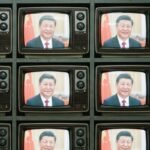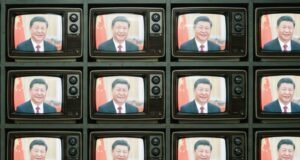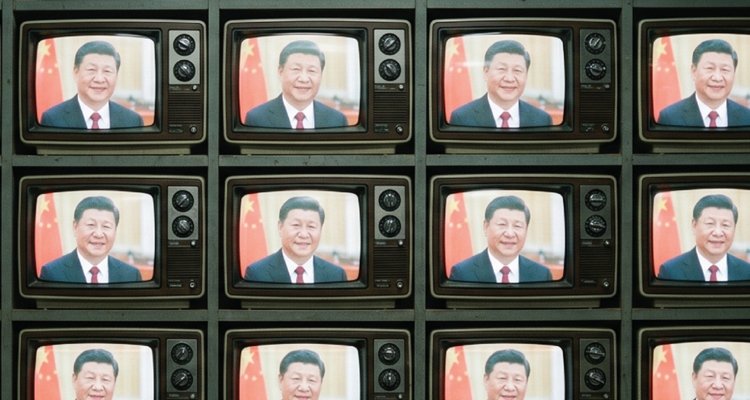
The first revelation of a new Safeguard Defenders report on China’s global TV network is old news: that CGTN insists on the same pervasive censorship and propaganda practiced by the domestic state television network CCTV.
What is new are the accounts of what it’s like to work for CGTN that the authors gathered from former foreign employees. The recollections are unattributed because, as the authors say, “no one wanted us to use their name openly.” They feared reprisal or the impact on their career “as they had moved on to other global news outlets.”
The setting
“In the newsroom everything was broken and falling apart. Panels were falling off desks and there were not enough chairs.”
“In Western newsrooms, it’s loud and mad and busy and exciting, adrenaline is pumping, there’s people having heated debates across the room. That newsroom in China was like a library.”
“There are literally no telephones to talk between the planning desk and the newsroom. Nobody’s checking their emails for breaking news.”
The propaganda
“Everything about Xi Jinping and the government and their aims had to be perfect before it was broadcast.”
“We would cover hour-long or two-hour-long speeches by the Agriculture Ministry…. It was expected that [we] would cover these conferences even if that wasn’t going to appeal to the audience.”
“Three quarters of the rundown is all Xi Jinping news.”
“I didn’t think I would necessarily mind the propaganda—I’m just a subeditor. My name’s not on there, my face isn’t up there. But it did, it bothered me a lot. There’s no way you cannot be affected by it…. Embarrassment, shock, disappointment, complete disbelief at the kinds of standards, kinds of nonsense you’d have to put up and say that’s news.”
The script
“I was never allowed to write my own questions or rewrite stories. I couldn’t have a computer on set or a phone. I couldn’t have access to any information in the studio like if there was breaking news, they would say, ‘Just follow the teleprompter’.”
“I had a reporter covering a landslide somewhere and [I skipped one question because the reporter had already answered it in her piece to camera]. Then on my way home on the subway someone called me and asked, ‘Why didn’t you ask the second question?’… I’d broken the unspoken rule of only following what was on the teleprompter.”
Control
“It was a weird dynamic, a different reality…. At every twist and turn you had to watch what you say on air or off air in case the wrong ears picked up on it. It was awkward working in that controlled environment.”
“I never freaked out about that [surveillance]. We joked about it on WeChat…. It’s terrifying to think how blasé I was about it. Of course I knew we were being monitored. But at the same time I thought they don’t care about me. I’m just…a foreigner.”
“When they [CGTN staff] had to rely on their own judgment, they became paralyzed with indecision, because of course they’re not used to using their own judgment and are fully aware of how treacherous that can be.”