The fate of 24 Kuomintang lawmakers in the Republic of China will be decided on Saturday, July 26, 2025, and of several others in August.
Since the presidential election of January 2024, KMT legislators have worked to prevent ROC President Lai Ching-te’s administration from strengthening Taiwan’s defenses against the ever-belligerent mainland. In frustration, activists in Lai’s Democratic Progressive Party launched recall campaigns against many KMT members of the Legislative Yuan.
So far, 31 KMT lawmakers are facing recall votes. A retaliatory campaign by the KMT to recall DPP lawmakers went nowhere.
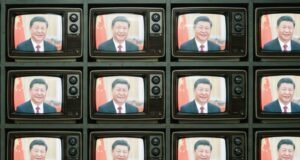
Reuters says that the jeopardized incumbents “are getting two unusual supporters: Chinese officials and state media outlets rallying to their cause.”
This is unusual how, exactly?
Almost anything the Chinese Communist Party can do to undermine the Republic of China, short of full-scale invasion, it does; this is very usual. And for whatever reasons, the Kuomintang that had long been the bitter enemy of the Chinese Communist Party strives these days to appease it; as the Associated Press puts it, the KMT of today is “seen as close to China” (January 24, 2025):
The DPP won last year’s presidential election, but came up short in the legislature.
Since then, the China-friendly Nationalists, also known as the KMT, and their allies have sought to hobble the power of the executive and blocked key legislation, especially the defense budget.
That has been seen as undermining both Taiwan’s hard-won democracy and its ability to deter China’s threat to invade the island it considers its own territory. Those concerns prompted activists to campaign for recall votes in the districts where Nationalists were seen as most vulnerable, and they succeeded in 24 districts where votes are scheduled this weekend.
A recall measure must win 40% of the constituents in a district to succeed, after which a special election will be held to fill the seat, in which all parties can compete.
The Diplomat adds:
In 2024, the KMT’s efforts to expand legislative powers stoked public anger. The party narrowly controls the legislature, but has failed to capture the presidency since 2012. The law passed last year would have allowed for legislators to summon citizens, government workers, corporate executives, military officials, and others for questioning, with fines imposed on those who declined to comply or who answered untruthfully…. KMT legislator Ma Wen-chun had shortly before been accused of leaking details of Taiwan’s domestic submarine program to the Chinese government. This led to concerns that these powers would be used to force members of the military to reveal confidential details of Taiwan’s defense program. Anger against the KMT’s actions sparked what later came to be known as the Bluebird Movement, the largest protest movement in Taiwan since the 2014 Sunflower Movement.
The requirement that at least 40 percent of a district’s constituents vote in favor of recall in order to force a special election means that if turnout in a district is meager, a majority vote in favor of booting the incumbent could be insufficient to trigger the special election. But with so much interest in the recall battle, so many outcomes being decided on a single day, and so much riding on the overall outcome, such discrepancies seems an unlikely result of the July 26 round of recall elections.