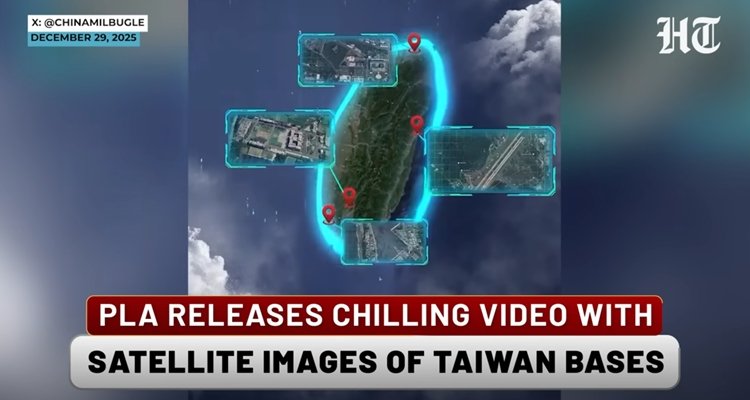
China’s massive December 29-30 Justice [sic] Mission 2025 war games are old news, and/or cross (another) red line in the CCP’s efforts to intimidate Taiwan, and/or are purely performative.
ISW Publications reports:
Justice Mission 2025 rehearsed operational elements of a campaign to isolate Taiwan while using the rehearsal to enhance the PRC political and psychological pressure on Taiwan and its allies. The exercise emphasized the use of naval and coast guard assets to enforce a blockade around Taiwan and rehearsed counter-intervention operations. The exercise did not involve PLA Navy (PLAN) aircraft carriers, suggesting that it was intended to practice only part of a larger blockade operation. The exercise reportedly included rehearsals of amphibious and air assault operations off Taiwan’s east coast as well as long-range rocket fire.
PRC propaganda emphasized the blockade aspects of the exercise, but it may also have been intended to practice combining blockade/interdiction missions with operations that would support a decapitation strike or invasion of Taiwan. The PRC used the exercises as a coercive signal intended to weaken Taiwanese morale and deter Taiwanese leaders from policies that support Taiwanese sovereignty and self-defense.
ISW elaborates on its website, UnderstandingWar.org.
Same old same old
President Trump says that he is not worried about the late-December drills around Taiwan (Newsweek, December 30, 2025).
Speaking to reporters during a press conference with Israeli President Netanyahu at Mar-a-Lago, Trump said he had not been informed in advance of the exercises but said he was not worried, arguing China has been “doing naval exercises for 20 years in that area.”
“I have a great relationship with President Xi,” continued Trump. “And I don’t believe he’s gonna be doing it” [presumably, not going to be invading Taiwan for real on Trump’s watch].
Asked if the exercises worried him, Trump said: “No. Nothing worries me.”
The drills…were announced less than two weeks after the U.S. approved a major arms package for Taiwan, and amid Beijing’s anger over ongoing U.S. support for Taipei.
Taiwan’s government and military have repeatedly warned that China’s “gray zone” operations—frequent aircraft and vessel activity near the island—raise the risk of miscalculation even if Chinese forces do not cross into Taiwan’s territorial airspace or waters. The naval drill activity and aviation disruptions were significant enough to affect large numbers of travelers and flights.
Strategic ambiguity
Jianli Yang of National Review concludes that Beijing is “Weaponiz[ing] Strategic Ambiguity on Taiwan.”
Beijing framed the operation as a response to Washington’s recent approval of an approximately $11 billion arms package for Taiwan and Japanese Prime Minister Sanae Takaichi’s November statement that “a Taiwan contingency is a Japan contingency,” which echoed long-standing Japanese security assessments linking Taiwan’s fate to Japan’s own defense posture. Official statements from the Chinese government described the drills as a warning to “Taiwan independence forces” and “foreign interference.” Yet judged by scale, proximity, intensity, and real-world impact, “Justice Mission 2025” cannot be accurately understood as a conventional military exercise—or as a typical, one-off political response to Taipei, Washington, or Tokyo.
What makes this operation fundamentally different is not only how close the PLA moved, but how it moved. Past exercises were announced in advance and followed a predictable pattern, with clearly delineated zones, timelines, and preparation phases….This time, the boundary between preparation and execution was blurred. The suddenness, the live fire inside territorial waters, and the immediate disruption of civilian life all marked a qualitative shift… This action looks less like a carefully calculated exercise and more like a deliberate attempt to erase the line between drills and war.
This recent operation marks the inauguration of a new strategy that can be described as Beijing’s strategic ambiguity. Its core logic is to normalize the isolation of Taiwan while systematically blurring the distinction between routine military activity and imminent combat.
Yes, but I don’t think that the strategy is really new, i.e., that the CCP hasn’t already and very often blurred the distinction “between routine military activity and imminent combat.” Isn’t this what the Party’s continuous gray zone activities and testing of limits—in the Taiwan Strait, South China Sea and elsewhere—are all about?
At a certain point, a difference in degree may become a difference in kind, and the People’s Republic of China may launch a full-scale war. If the People’s Republic of China does go to war against the Republic of China, it may well begin by staging a fake military drill. But waging what anyone would agree is war is not the same as conducting a military exercise that, however line-blurring, does not cross that line.
Purely performative
In a recent video on the Lei’s Real Talk channel, Lei sees the war games in light of what in her view is a continuing power struggle in the CCP between General Zhang Youxia and the man at least nominally at the top of the CCP hierarchy and in charge of everything, Xi Jinping. (In previous videos she explains her reasons for saying so, arguing against those who believe that Xi has himself been directing the purge of top Xi loyalists in the military.)
“Xi Jinping’s provocation is purely performative. It’s meant to remind people that he still exists, that he still matters politically and in military affairs. He wants people to believe a war is imminent so as to stress his existence.
“But in reality, he does not want a real war because he cannot afford to [launch one]—because he doesn’t really fully control the military. Zhang Youxia, on the other hand, also doesn’t want war. But he has no problem letting Xi Jinping play the strongman. He doesn’t care one way or the other. As long as Xi remains chairman of the Central Military Commission, any escalation, any fallout, any international backlash will land squarely on Xi, not him.”
Lei also suggests that the Chinese people, judging by their online comments, have been resistant to CCP propaganda about the “Justice” exercises. “Even though Beijing tried to hype this exercise as something massive and overwhelming, guess what? Taiwan’s stock market didn’t fall. It actually went up. And perhaps most embarrassing of all, mainland Chinese netizens flooded the internet with jokes and ridicule aimed at the PLA [People’s Liberation Army] and their government….
“In the end, the CCP’s military drill is exactly what it looks like, a theatrical performance, not a war exercise, even though Beijing wants us to panic and believe otherwise. And that is precisely why Trump’s comments were so enjoyed by the mainland Chinese netizens, because they didn’t just dismiss the drill: they landed like a slap in the face to Beijing.”
Old news
Bill Gertz of the Washington Times says that the war games are practice for a takeover and also discusses the drills as warnings “to Japan and the United States in addition to the self-ruled democratic island.”
In the first report, Gertz writes that the Chinese Foreign Ministry “linked the drills to U.S. arms sales to Taiwan following the recent Trump administration announcement of an $11 billion package of arms for the Taiwan military.”
In another piece, though, Gertz quotes Grant Newsham, a retired Marine Corps colonel with expertise on China, who “said the latest exercises are not a response to any [recent] actions taken by the U.S. or Japan. He noted that American arms sales have been transpiring for years and Beijing knows well that Japan would be forced to act in response to a Chinese attack on Taiwan.”
Also see:
StoptheCCP.org: “What War Between Beijing and Taipei Would Really Mean”