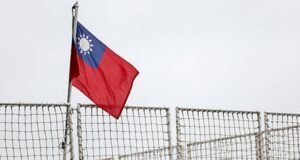
The People’s Republic of China disdains the recent U.S. trade agreement with the Republic of China.
The deal reduces U.S. tariffs on most imports from Taiwan to 15%. For its part, the ROC agreed to “remove or reduce 99% of its tariff barriers, the office of the U.S. Trade Representative said.” But President Lai Ching-te “stressed that the rate on 93 items would remain unchanged to protect important agriculture and industrial sectors such as rice farming.”
The deal is not quite done. The agreement must still be accepted by the opposition-dominated ROC legislature (Associated Press, February 13, 2026).
The 15% rate is the same as that levied on other U.S. trading partners in the Asia-Pacific region, such as Japan and South Korea….
In a separate but related deal, Taiwan will make investments of $250 billion in U.S. industries, such as computer chips, artificial intelligence applications and energy. The Taiwanese government says it will provide up to an additional $250 billion in credit guarantees to help smaller businesses invest in the U.S.
The investments helped enable the U.S. to reduce its planned tariffs from as much as 32% initially to 15%.
Guo Jiakun, a spokesman for the Chinese Foreign Ministry, says that “China always firmly opposes countries…signing any agreement that carries sovereign connotations and an official nature with China’s Taiwan region.”
But the implication that the ROC is not a region of the PRC but an independent state with which another state can do a deal is in fact one of the good points of the trade agreement. Thanks, Guo, for, contrary to your intention, underscoring this valuable feature of the U.S.-ROC deal.
Same as others
Best would be no tariffs or other barriers on trade imposed by either side when the negotiating countries are not hostile toward each other. But if a 15 percent tariff is the Trump administration’s current rock-bottom surcharge on imports from friendly countries, the agreement at least puts the Republic of China on a par with other friendly or friendly-ish trading partners.
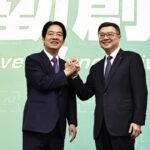
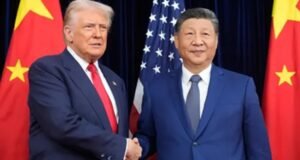
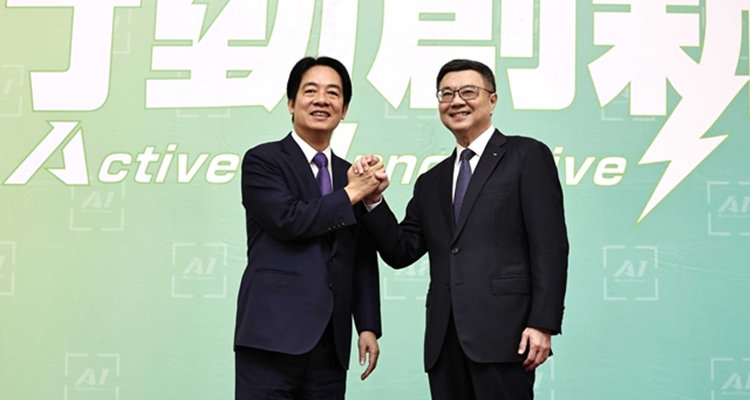
“Our goal is to lower mutual tariffs,” says ROC Premier Cho Jung-ta (shown above, right, with President Lai Ching-te). “Taiwan has successfully obtained 15% in tariffs with no added fees. This is the same tariff imposed on Japan, Korea and the European Union.”