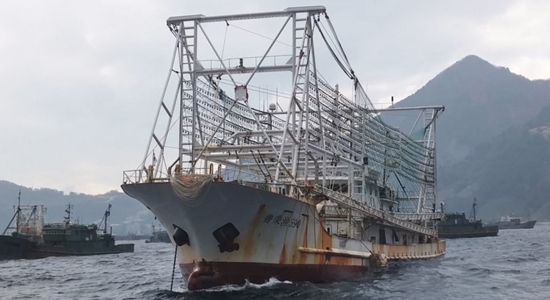
Around the world, the industry of deep-water fishing is “notoriously murky.” But Chinese fishing fleets stand out as the most rapacious, according to a December 2022 report by The Economist.
China is not the only state with an eye on protein and profit far from its own waters. Japan, South Korea, Spain and Taiwan have fleets of their own. But it is by far the biggest. Some estimates put its size at over 3,600 boats, as many as the next three biggest combined. And unlike others’ fleets, China’s consciously projects state power and influence, sometimes as part of Xi Jinping’s signature economic and geopolitical project, the Belt and Road Initiative. A significant number of Chinese vessels are state-owned.
A third differentiating feature is the fleet’s rapaciousness and lack of scruple in an industry notorious for both. In its wake comes overfishing, some of which is outright illegal; the collapse of local stocks; smuggling; links to organised crime; and the forced labour and general mistreatment of those who serve on the boats.
Chinese fishing vessels often venture into the exclusive economic zones of other countries secretively and against the wishes of country governments, switching off location-transmitting transponders as they approach exclusive economic zones. But sometimes they fish in foreign waters because the governments have agreed to let it happen—at the expense of local fishermen who can’t compete with China’s giant fish-depleting operations.
You may have trouble fishing for a living especially if you live in west Africa.
The Chinese government publishes a list of foreign countries within whose 200-nautical-mile (370km) “exclusive economic zones” (eezs) it has agreed contracts for fisheries operations. Over half of such agreements have been made with west African countries. Senegal is one. Mauritania to the north, vast and poor, accounts for nearly 30% of the total by itself.
The projects include not just the rights for Chinese vessels to fish in states’ coastal waters, but also to establish operations such as processing plants ashore. Mauritania has become a hub in the industry for fishmeal and fish oil. Such products are bought by aquaculture farms that raise fish for customers in China and other countries. The sorts of fish hoovered up to make them include those long fished by locals using small boats and hand nets.
Proposed reforms include requiring governments that sign fishing agreements with China to make the agreements public and requiring Chinese fishing vessels to broadcast their positions. But China won’t agree to such suggestions voluntarily.
Also see:
StopTheChinazis.org: “Far-Flung, Frenzied, Illegal Fishing”
“In 2020, [the navy of Ecuador] discovered 340 Chinese fishing vessels off the Galapagos islands. In the uproar that followed, China declared a ‘zero tolerance’ policy towards illegal fishing’ and announced that it ‘was tightening the rules for its enormous flotilla.’
“The rules were not tightened enough. As late as December 2023, the organization Oceana could report that ‘China’s massive distant-water fleet flocks to the waters surrounding the Galápagos Islands, then frequently disappears from public view by appearing to disable public tracking devices.’ ”