How is it reasonable to hedge against a speed-bumpy relationship with the United States by plunging into what already is and will be a much more troubled relationship with the People’s Republic of China? Yet this, argues Rob Pierce, is what current Canadian premier Mark Carney—who in a previous incarneyation declared that “China represents the largest geopolitical threat we face”—is doing (National Interest, November 9, 2026).
Canada’s newly released national security strategy, its first in more than 20 years, formalizes Carney’s pursuit of “strategic autonomy,” warning that economic integration has become a source of vulnerability while calling for diversification of Canada’s international partnerships. But Carney’s approach risks making Canada more vulnerable to the exact kind of great-power coercion he ostensibly opposes.
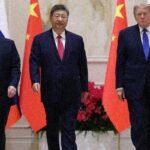
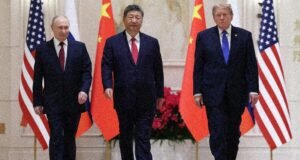
Nowhere is this more evident than in Canada’s relationship with China, with whom Carney [shown above] recently forged a “strategic partnership” with deals focused on energy, agriculture, and trade. Announced after Carney’s January visit to China, during which he embraced Chinese President Xi Jinping’s self-presentation as a staunch defender of multilateralism, the Canada-China partnership will, among other things, allow up to 49,000 Chinese electric vehicles (EVs) into the Canadian market at the lowest most-favored-nation tariff rate of 6.1 percent.
Never mind the well-documented espionage concerns posed by Chinese EVs due to the collection of location, sensor, and other sensitive data, the influx of Chinese cars, built with the help of unfair state subsidies, undermines the Canadian and American automobile industry, risks putting thousands out of work, and increases China’s leverage over the Canadian economy. The national security strategy promises to choose “long-term strength over short-term expediency,” but Carney’s policy actions deepening economic engagement with Beijing undercut that commitment. Additionally, China operates a dense network of organizations in Canada linked to the Chinese Communist Party’s United Front system, putting political leaders and civic institutions at risk of malign Chinese influence campaigns.
Although Pierce apophatically urges us to never mind about the ability of state-subsidized Chinese vehicles to conduct espionage on behalf of the Chinese party-state, this is not a threat that should be downplayed.
Autonomy
Addressing the U.S. context, AEI observes that as cars “become more autonomous, they’ll become more capable at mapping the world around them. We’ll have more cameras and lidar gathering data from our streets. Certain types of external sensors create more risks.” It’s a bad idea for these sensors to be provided by firms in China, yet “Chinese components have surged into US automotive supply chains.”
Beijing would not be interested in all the drivers and all the surroundings of all the vehicles to which it has remote access. It would use artificial intelligence to churn through the vehicle-collected data and zero in on items of special interest.
As AI makes it easier to filter data, all foreign intelligence agencies will gather as much data as they can, even before ascertaining whether a specific piece is likely to be valuable. Unexpected patterns can emerge across a broad range of data points, even if each individual point seems irrelevant or innocuous….
A foreign intelligence service’s broad access to near-real-time camera data could allow detailed mapping of critical infrastructure. It could enable tracking of traffic into sensitive locations, like military bases or the Pentagon. Recent research by a Norwegian cybersecurity group led by Tor Indstøy has found that a Chinese NIO-brand car has exterior cameras capable of facial and license plate recognition. [NIO is a Shanghai-based EV-maker.]
The authors are warning about the use of China-produced components in U.S.-made vehicles. Their warnings would equally or even more emphatically apply to vehicles imported from China made entirely by companies that are subject to Chinese Communist Party oversight.
Also see:
AEI: “Connected and Autonomous Cars: Security Risks from Chinese Components” (May 15, 2026)