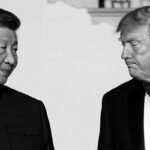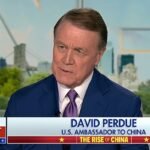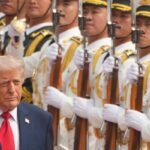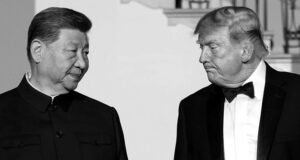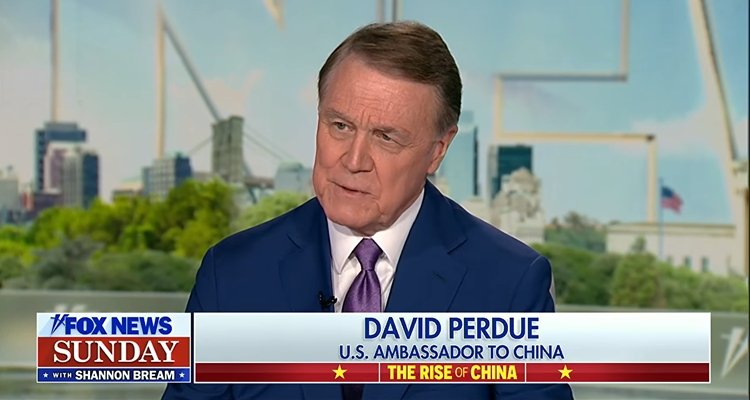
What are we to make of this? David Perdue, U.S. Ambassador to China, says that at one point, maybe during President Trump’s talks with Chinese dictator Xi Jinping in Washington last week, Trump suggested, jocularly, one must assume or pray, that the U.S. sell arms to the People’s Republic of China.
Fake deals
Meanwhile, the Trump administration has been holding up a $14 billion arms sale to the beleaguered Republic of China (The New York Times, September 27, 2026).
President Trump has asked Xi Jinping, the leader of China, whether he would like to buy American weapons, David Perdue, the American ambassador to China, said in a television interview on Sunday.
“President Trump continues to say, ‘Hey, we sell arms to other people around the world,’ ” Mr. Perdue said on “Fox News Sunday” while discussing the state visit by Mr. Xi to Washington last week. “He actually asked President Xi would he like to buy some at one point.”
Mr. Perdue did not give further details and did not reveal Mr. Xi’s reply. [Nor was he asked about these details by the Fox interviewer.] An admission that the American president offered to sell arms to China is extraordinary. The Communist-ruled nation is considered by most American policymakers and legislators of both parties to be the greatest military, economic and diplomatic rival of the United States—the only real challenger to America as a superpower.
When asked for comment, the White House said through a U.S. official that the United States had no plans to sell arms to China. The State Department said in a statement that “U.S. law prohibits arms sales to China and there is no offer or plan to sell arms to China.”
The Chinese Embassy in Washington did not immediately respond to a request for comment.
Why did the Chinese defer comment? The press release writes itself.
“Why, yes, we did agree to by arms from the United States, about $14 billion worth, and we will be immediately distributing them to the Iranians and the Houthis and other important partners, like Russia to help them with Ukraine and Europe, as well as aiming them at Taiwan. This is a new dawn of a new day of a new era of U.S.-People’s Republic of China relations.”
“Rival” is understatement. The PRC is the totalitarian arch enemy of the United States, the Republic of China, and many other countries, even if Trump often for whichever reasons of psyche or diplomacy treats its head of state as if they were bosom buddies.
Like to buy some
“He actually asked President Xi would he like to buy some at one point.” Probably a joke, though it seems unfathomable on any reading. (But if the statement clearly was not serious, why would Perdue repeat it except as sabotage, or, almost worse, just to show what an insider he was in these talks?)
The United States did, unfortunately, at one time sell arms to China, in hopes of offsetting the Soviet Union. According to an EveryCRSReport.com:
Since the mid-1970s, even before the normalization of relations with Beijing, the debate over policy toward the PRC has examined how military ties might advance U.S. security interests, beginning with the imperatives of the Cold War. In January 1980, Secretary of Defense Harold Brown visited China and laid the groundwork for a relationship with the PRC’s military, collectively called the People’s Liberation Army, intended to consist of strategic dialogue, reciprocal exchanges in functional areas, and arms sales.
Furthermore, President Ronald Reagan changed policy in 1981 to remove the ban on arms sales to China. Secretary of Defense Casper Weinberger visited Beijing in September 1983. In 1984, U.S. policy makers worked to advance discussions on military technological cooperation with China. There were direct commercial sales to the PLA that included Sikorsky Aircraft’s sale of 24 S-70C transport helicopters (an unarmed version of the Black Hawk helicopter) and General Electric’s sale of five gas turbine engines for two naval destroyers. Between 1985 and 1987, the United States also agreed to four programs of government-to-government foreign military sales: modernization of artillery ammunition production facilities; modernization of avionics in F-8 fighters; sale of four Mark-46 anti-submarine torpedoes; and sale of four AN/TPQ-37 artillery-locating radars.
That stopped, mostly, after Tiananmen Square. There was no excuse for such sales back then, less now that “China’s rising power with greater assertiveness and aggressiveness (particularly in maritime areas), refusal to discuss nuclear weapons, cyber threats, and repeated suspensions of visits showed limitations of the results of mil-to-mil [military-to-military] exchanges.”
Transcript
Following is a part of Perdue’s exchange with the Fox News interviewer. The ambassador’s murky statements about China’s help to Iran and about how Trump’s delay of the $14 billion in arms sales to the Republic of China absolutely is not a Taipei-undercutting delay precede the stuff about selling arms to Xi.
“President Trump is as strong on Taiwan as I’ve ever seen; anybody,” Perdue says.
Iran
Fox: You have said we made clear to them that any help China is giving to Iran is totally unacceptable. You know the reporting on this, that they are sending parts that can be used in drones, that they are sharing intelligence that could lead to U.S. service members being killed, and they’re still the major buyer of Iran’s oil. So, what was the message and what are the consequences if China does continue to assist Iran?
Perdue: Well, President Trump for some time has made it very clear that any help that China would give Iran, whether it be intelligence or parts or direct military equipment, would be totally unacceptable. He reiterated that this week. President Xi assured him that changes had been made, that they were looking into it, they had looked into it, and we see some improvement in that. But it’s an ongoing effort that we have to make sure that they stay out of that.
By the way, in May, and they reasserted it this time, they have agreement on some major issues. These were, I think, very successful results of a conversation we’ve had been having with them. And that is—President Xi Jinping agreed in May, and he reiterated it here—that they support no nuclear weapon in Iran. That’s huge. Secondly, they support an open Strait of Hormuz. And third, they support forever no tolls in the region.
Fox: So what do you say to lawmakers who are concerned about exactly what is happening and what we are allowing to go on? I want to play something from Senator Blumenthal. He’s a Democrat, clearly had many problems with this visit this week.
[Blumenthal clip: “For the president to be feting and celebrating Xi while he is aiding Iran, which is trying to kill our sons and daughters, is absolutely abhorrent. And I am shocked and deeply alarmed that the president, in effect, is kowtowing to him and failing to release the money that Taiwan needs to defend itself.”]
And I want to get to Taiwan, but before we leave this issue of Iran, what are the penalties? What are the sanctions…when it comes to these threats regarding Iran and China?
Perdue: Well, Senator Blumenthal is a friend of mine, an ex-colleague, and while we differ on this, there are things going on that he hasn’t mentioned there. For some time, we’ve been sanctioning companies that have been aiding Iran. There are other things that we can do, and China knows that. We’ve told them about that. The main thing right now, though, is that we continue the drumbeat of these conversations. This is the third top-to-top meeting we’ve had between President Xi and President Trump [during this second Trump term]: Busan, May [in Beijing], and now Washington DC….
We’re galvanizing the rest of the world about Iran. We’re galvanizing the rest of the world about the weaponization of some of these single-source dominant positions that China has. And it’s gratifying to see the allies now, even though we have trade disagreements with them, that we see them coming to us about that.
Republic of China
Fox: Okay, let’s talk Taiwan. Because there are billions in aid packages and arms and weapons, orders from Taiwan, that are sitting on the sidelines. A number of senators including Republicans, they’ve sent a letter over to Secretaries Rubio and Hegseth saying they’re very concerned about this. It reads in part, “It’s difficult to imagine how the United States might credibly project influence deterrence in the Indo-Pacific if the price of keeping up diplomatic appearances is denying our partners key deterrent capabilities.”
Are we denying what Taiwan says it needs to defend itself in order to appease Xi and what is the message to Taiwan?
Perdue: Well, first of all, that’s absolutely not the case. I can tell you, I’ve been in every one of these conversations. President Trump is as strong on Taiwan as I’ve ever seen; anybody. He’s made it very clear that we have not changed the one-China policy. We support the Taiwan Relations Act, the three communiques, the six assurances. President Xi has heard that repeatedly from President Donald Trump. President Trump has already sold 50 percent more arms to Taiwan than any other president since 1979. And so, I don’t accept the premise that, you know, he’s not doing all that we should be doing for Taiwan.
Fox: Will those things move forward? Will the delays, whatever they may be on these, you know, $20 billion in aid and armaments, will that be expedited?
Perdue: Well, earlier President Trump’s already approved 11 billion. There are continuing conversations about other sales. He and President Xi talk about that every time they get together. But, President Trump continues to say [re selling arms to the ROC, presumably], “Hey, we sell arms to other people around the world.” He actually asked to President Xi would he like to buy some at one point. But our support for that has not changed. We don’t support independence [the U.S. does not “support” an established fact] and we don’t support coercion.
Fox: Okay, let’s talk about some other things…
Also see:
Fox News: “The 3 ‘HUGE’ developments from Trump-Xi summit, ambassador reveals”