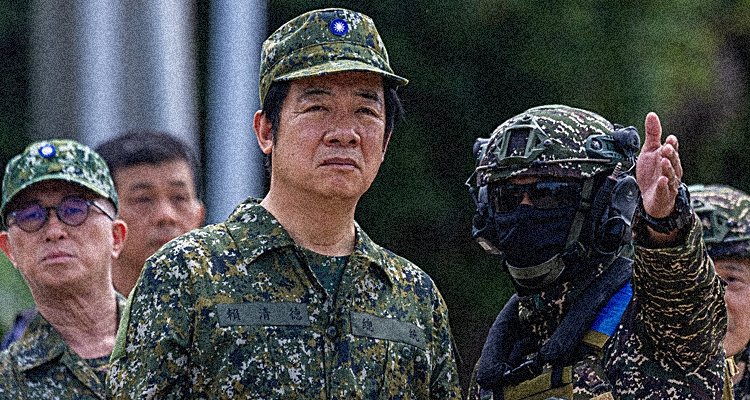
If everything happens all at once—blockade, sabotage, invasion, earthquake, unrest—the Republic of China wants to be able to cope with it. So the government threw everything but the kitchen sink into July 1-2 war drills designed to prepare officials and the public for crises in a more realistic way than “past drills often criticised as scripted, performative and of limited value” (Reuters, July 3, 2026).
The drill began with a seven-hour tabletop exercise before moving the next day to field drills that included shooting down a Chinese drone threatening a power plant and setting up food ration stations.
The magnitude 6.8 earthquake scenario, in which 12 people were killed, added another layer of stress, forcing officials to juggle disaster relief, disrupted infrastructure, rising public unrest and wartime contingency planning.
Displayed on large screens in the drill’s response centre were a U.S. military-developed tactical mapping and communications system giving officials real-time locations of enemy targets….
Dozens of grassroots government units across the country also joined the drills by livestream, responding to scenarios and rapid-fire questions from commanders in the response centre….
As the scenarios darkened, the atmosphere in the response centre grew more intense, with occasionally tense exchanges between commanders and subordinates, some of whom struggled to provide answers.
The drill also tested how local authorities would counter information warfare….
At one point, local television broadcasts were hijacked and replaced with Beijing propaganda, while misinformation flyers appeared on the streets—echoing a scenario in the 2025 Taiwanese television drama “Zero Day Attack.”
The early July exercises were a sequel to five days of drills conducted in June that were focused more narrowly on testing troops’ combat readiness.
As the July drills were concluding, Taiwan reported that its adversary across the Strait had conducted another “joint combat readiness patrol” around the island, “with warships and at least 22 military aircraft, including nuclear-capable H-6 bombers.”
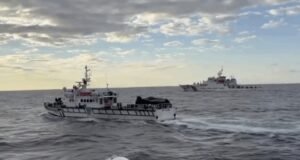
Then, on Saturday, the PRC announced that it “it had launched a new coast guard patrol east of Taiwan, drawing a sharp response from Taipei after a task force last month off the island’s coast caused alarm in some Western capitals.”
Tensions
In response to Taipei’s most recent exercises, China’s Taiwan Affairs Office said that President Lai is “deliberately escalating” tensions. The way acting in self-defense always escalates the tensions, presumably.
Despite their talking points, the apparatchiks in Beijing must know deep down inside that if the mainland were to stop bullying the ROC and stop threatening war, credibly and permanently, the cross-strait tensions would tend to fade. Even in that case, though, Taipei would still have to prepare for the possibility of Beijing’s changing its mind.
Reuters refers to previous ROC drills as having often been “scripted, performative, and of limited valued.” But large-scale drills were also conducted in Taiwan last year, when “more than 22,000 reservists took part over 10 days—a mobilisation unprecedented in both length and scale.” These were probably also somewhat scripted. The only way to be entirely unscripted is to have a real live war.
Also see:
The Independent: “Inside Taiwan’s largest ever military drill—and why it sends China a clear message” (July 18, 2025)
”As military threats from Beijing rise, the Han Kuang drills are helping the public prepare for the worst-case scenario…. The 10-day exercise is the most intense in Taiwan’s history.”