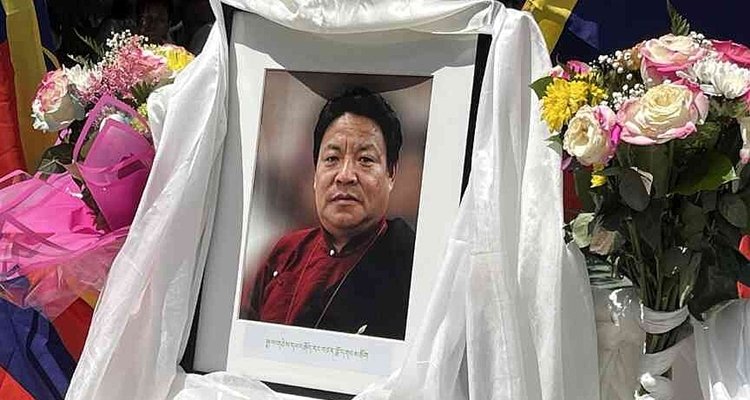
China’s rule over and coercive efforts to assimilate various ethnic and religious groups, described as promoting development and providing “lessons in governance” by one friend of tyranny, was not seen that way by Lobga Rangzen.
In protest against the PRC’s occupation of Tibet, Rangzen (shown above) burned himself alive in front of the United Nations building (News Tribune, July 5, 2026).
Lobga Rangzen also recorded a six-minute appeal for Tibet’s freedom and independence in his native language before putting on traditional monastic robes and walking to 42nd Street and First Avenue around 6:30 p.m. Thursday.
“So if I do a big action today, I want you to know it is not for any personal reason,” he said in the video. “It is not because I have nothing to eat or nothing to wear, but because I am doing this for my country. For the Tibetan nation.”
Outside the U.N. he put his phone down on the street and recorded his self-immolation….
Fliers reading “China out of Tibet” in his hands catch fire as they’re tossed onto the street….
Rangzen’s death came a day after China began enforcing the Ethnic Unity and Progress Law in Tibet. The law creates [correction: asserts] a “shared national identity” among China’s 55 ethnic minority group and gives Beijing the legal basis to take action against them….
There have been more than 150 self-immolations by Tibetans between 2009 and 2022, according to the International Campaign for Tibet.
Since the Chinese Communist Party has been taking vicious action against the members of various minority groups for decades on the only basis it needed—superior might, swathed in an infinity of propaganda—the announcement that the Chinese government has just now arrived at a “legal basis” for these policies is misleading.
The Tibetan Center for Human Rights and Democracy better describes the new Ethnic Unity law: it “further entrenches the state’s assimilation campaign under the guise of ‘ethnic unity.’ ”
Rangzen’s statement that he was not in desperate straits personally seems to be confirmed by friends cited in the report. A native of Tibet, he had lived in the United States for more than two decades and made his living as an Uber driver.
Also see:
International Campaign for Tibet: “Full English translation of Lobga Rangzen’s final public message” (scroll two-thirds down the page to see the translation)
“Today, what I have to say is that the Chinese Communists have persecuted all of us…. Today, when we say that we do not have human rights, that we do not have freedom of speech, that we do not have the freedom to display a portrait of His Holiness the Dalai Lama—if we examine why we do not have these freedoms, it is because we lost the independence of Tibet…. We have to regain our independence. Therefore, we Tibetans in exile must unite and struggle for the independence of Tibet.”
Bodja Podcast: Video: “Pawo Lobga Rangzen’s Final Message” (with English-language captions)
In addition to an introduction by Bodja Podcast, this video only shows Rangzen giving his statement.