China’s new Ethnic Unity Law endorsing the Chinese Communist Party’s longtime repression of various ethnic groups has been endorsed by the Chinese Catholic Patriotic Association. This is an ersatz Catholic association run by the CCP. It’s one of the tools the Party uses to try to convert all religious expression into expression of the ideology of socialism with Chinese characteristics.
There’s underground churches and religion, the real thing, whose devotees get hounded and arrested in the People’s Republic of China; and there’s registered, ideologized, “Sinicized,” CCP-offshoot religion.
Religion in the “new era”
In commentary for The Hill, Gordon Chang reminds us of the problem and the Vatican’s default.
Bitter Winter, a magazine that focuses on religious freedom and human rights in China, reported that local clergy were told to stress that the national law takes precedence over religious convictions, and believers must show loyalty to the state. The vigorous endorsement of the new ethnic law by the Chinese Communist Party’s recognized Catholic body comes at the same time that the party is trying to “Sinicize” religion to make it align with its values. Xi Jinping started this campaign in 2016….
In recent years, Xi has intensified the nationwide effort….
Moreover, this April, Catholics were ordered to implement the instructions of the 2026 national training session on the “Sinicization of Catholicism,” held at the Central Institute of Socialism in Beijing. Bishop Li Shan of Beijing, chairman of the Chinese Catholic Patriotic Association, opened the session by stating that the goal of “religious work in the new era” is to implement Xi directives. Catholicism, he stated, must reflect “Chinese characteristics”—in other words, Communist Party directives.
In 2018, the Holy See signed a pact with the devil. The exact terms are secret, but the agreement supposedly gave the Pope “final authority over selection” of bishops. The Party went on to appoint bishops on its own, minus any consultation, though perhaps with the Pope’s hapless pro forma approval after the fact. The agreement was renewed in 2020, 2022, and 2024, on the last occasion for four years instead of two.
Silent
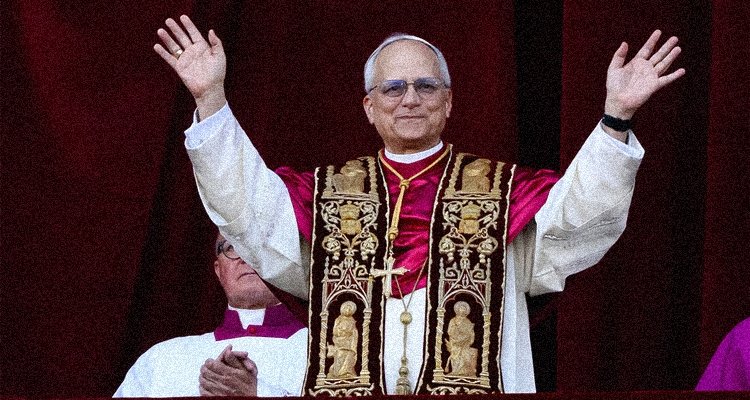
The only real function and benefit of the pact seems to have been to facilitate the Chinese government’s campaign to wipe out Catholicism as a distinctive enterprise. Pope Leo was not involved in any of the renewals, having been elected Pope in May 2025. On the other hand, neither has he announced that the agreement is an abomination which the Vatican regards as null and void.
“Beijing tells Catholics that the Vatican, by inking the agreement, has ordered them to join the Patriotic Church,” writes Chang, “but in 2019 the Holy See publicly stated that was not the case. Nonetheless, the damage was already done….
“Beijing has predictably tried to use the Patriotic Association to persecute the underground church, but now it is also using the group to get the church on record on a matter that is tangential to religion—the ethnic unity law. So far, the Vatican has remained silent.”
Some of these words may be misleading. Is any evil such as that represented by the Ethnic Unity Law really no concern of the Catholic Church—“tangential”? Also, the CCP doesn’t want China’s Catholic Churches, whether underground or registered, merely “on record” about the law. The requirement is explicit approval.
Also see:
Bitter Winter: “China’s Patriotic Catholic Church Promotes the Ethnic Unity Law”
“The Chinese Patriotic Catholic Church has entered a new phase of political usefulness. In recent months, its official websites and regional branches have devoted sustained attention to the Law on Ethnic Unity and Progress…. The Church that Beijing recognizes as Catholic has become an active participant in the state’s campaign to reshape ethnic and religious identities according to Party doctrine.”
The Irish Times: “Pope’s deal with Communist party in China draws criticism from some Catholics”
Sergio Ticozzi: “The Chinese authorities want clearly to eliminate this section of the church, and exploit the ambiguous and silent attitude of the Vatican to achieve their objective. They openly make use of the Sino-Vatican agreement for this purpose: they do not show great concern about providing bishops for the more than 30 vacant dioceses, but prefer to propose their own episcopal candidate for dioceses which already have unofficial bishops, in order to force the Vatican to order the latter to accept the government solution, which can be rather unjust.”