Censorship doesn’t prevent young Chinese moviemakers from making movies. “In the age of iPhones and cheap, portable equipment,” the technological and financial barriers are much lower than they used to be. But it may prevent their work from being shown in the People’s Republic of China and even overseas—however much the country’s young filmmakers “are undaunted by red lines,” as a Guardian headline contends (June 6, 2026).
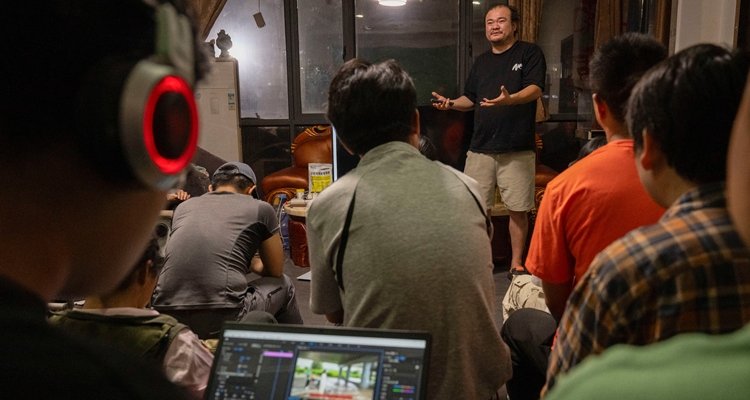
“I tell students not to think about censorship,” says Nan Xin (shown above), an independent filmmaker who also conducts popular workshops on the craft. “It’s not the young people’s responsibility that Chinese cinema has come to this situation.”
The second statement is not really connected to the first. Young people didn’t create the world they have to deal with. But they still have to deal with it.
And out of earshot of his students, Nan Xin admits that “the moment they decide to make a feature film, censorship will become their nightmare.”
Another filmmaker, Gus Xiaodong, says that the censors don’t worry very much about short films, not expecting them to have much influence. But when it comes to making feature films, “censorship will play a very important role in the creative process.” Perhaps the way a broken leg plays a very important role in the running process.
Negative things
Many of Nan’s students say they’re not worried about the censorship. Yet some are already steering clear of the subjects and treatments most likely to get a thumbs down from the censors.
Han Xizhu, a 24-year-old engineering graduate, says there are no limits to his creative vision. “I haven’t really felt a lack of freedom,” he says. China’s censorship requirements only restrict “negative things”.
Han dreams of making “light and relaxed” films about personal relationships, like Woody Allen’s Annie Hall. “It doesn’t have to discuss some major theme, or link back to society and all that.”
The choice to focus on the personal rather than the societal is one that many young filmmakers are making, whether or not they are consciously influenced by the censorship regime. “It’s really difficult to look outward. A lot of people just focus on their family stories,” says [a leading independent documentary director].
Han Xizhu has convinced himself—or anyway tells himself—that he will never want to creatively talk about those “negative things”—human problems that the CCP doesn’t want films to dramatize or dramatize in the “wrong” way. But what if in a few years he does want to stray into forbidden territory?
A low-budget film by his teacher, Nan Xin, “Go Fishing” (2022), has been shown in international film festivals but never in mainland China. Reason: “does not align with core socialist values.”