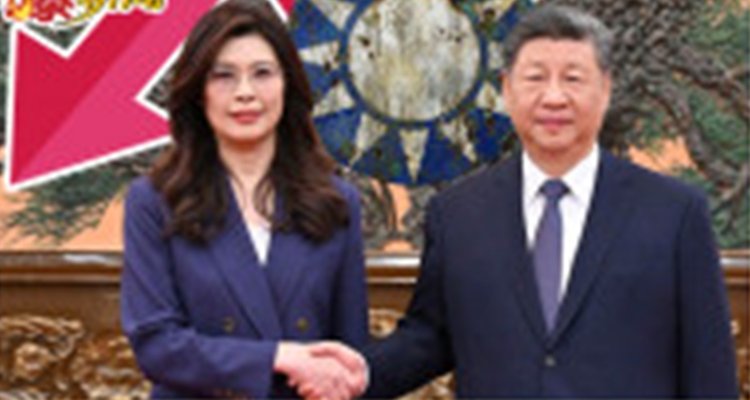
As PRC dictator Xi Jinping and Kuomintang chairwoman Cheng Li-wun were trading fictional insights about the requirements of peace in our time, the ROC’s defense ministry was counting “16 Chinese warplanes operating near the island” of Taiwan on the day of their meeting, Friday (Reuters, April 11, 2026).
Late on Friday morning, Chinese President Xi Jinping met Cheng Li-wun, chairwoman of Taiwan’s largest opposition party, the Kuomintang, in Beijing, where Xi said he “absolutely would not tolerate” independence for Taiwan, which China views as its own territory [even though it has never been governed by the People’s Republic of China]….
Shen Yu-chung, a deputy minister at Taiwan’s China-policy-making Mainland Affairs Council, told reporters in Taipei on Saturday that using military coercion against Taiwan as a means of applying pressure for political negotiations has always been China’s “go-to tactic”.
“So on one hand we see them sending out messages of peace, while on the other hand they continue to use military force to pressure Taiwan without letup.”…
In Beijing, KMT Vice Chairman Chang Jung-kung said that the key to promoting peace lies in offering Taiwan’s people a choice between peace and reconciliation [i.e., submission to Beijing], or war.
KMT Vice Chairman Chang is selling what KMT Chairwoman Cheng is selling, and they listen meekly to the same instruction. The English-language People’s Daily Online relays Xinhua’s report on Chang’s Friday meeting with a top Taiwan affairs official, Song Tao.
Song, head of both the Taiwan Work Office of the Communist Party of China Central Committee and the Taiwan Affairs Office of the State Council, said at the meeting that based on the common political foundation of upholding the 1992 Consensus and opposing “Taiwan independence,” the mainland is ready to work with the KMT to oppose secessionist activities and crush any attempts by Japan or other external forces to interfere in affairs related to Taiwan.
He called for efforts to strengthen cross-Strait exchanges and cooperation, advance peaceful development across the Taiwan Strait, and strive for national reunification and rejuvenation.
Cheng articulated her hope that cooperation between the Kuomintang and the Chinese Communist Party would serve to promote the “institutionalization” of peace in the Taiwan Strait.
It would be easy to achieve a viable peace, one that does not destroy the Republic of China, if the political will were there. Here’s the framework: the ROC agrees not to attack the PRC, not even a little, and the PRC agrees not to attack the ROC, not even a little, and the former accepts the independence of the latter.
But if Xi and/or the CCP would never agree to this formula, what is it that Cheng and Chang can do to further the cause of tranquility in the Taiwan Strait but push their country further along the path of surrender to the “rejuvenating” tyranny of Beijing?