Members of the Kuomintang and Taiwan People’s Party who oppose elements of the ruling party’s proposed military budget give various reasons for their opposition. Unstated is the probably biggest, or real, reason: they don’t want to provoke the bully across the strait. Meanwhile, ignoring all attempts to make nice, the bully is working to shred the Republic of China’s existing defenses.
In its latest China & Taiwan Update, the Institute for the Study of War suggests that the deadlock in the Legislative Yuan is “preventing Taiwan from acquiring systems critical to modern warfare” and “also delaying Taiwan’s acquisition of traditional warfighting systems, potentially damaging Taiwan’s military readiness” (April 3, 2026).
Why “potentially”? Go with your assessment, ISW. If Taipei’s acquisition of certain modern and traditional defense systems is critical to military readiness, and politics is impeding the acquisition, the ROC’s military readiness is being damaged. The damage can be repaired. But if it’s happening, it’s happening.
Both the TPP and KMT versions of the budget, which total around $12 billion, only fund conventional procurements and omit funding for large-scale drone procurement and IAMD [integrated air and missile defense] systems. Conflicts in the Middle East and Ukraine illustrate that widespread use of unmanned systems has reshaped modern warfare through the ability of low-cost systems to create battlefield transparency and a pervasive threat of precision strikes. The proliferation of long-range strike drones paired with precision missile strikes likewise necessitates an IAMD network capable of addressing such threats. A special budget that omits funding for significant numbers of unmanned systems and a Taiwanese IAMD network will leave Taiwan with limited ability to integrate lessons from foreign conflicts into its defense posture. It will also limit Taiwan’s ability to build its domestic drone industry, which is critical to reduce dependence on imported systems.
The ROC is also delaying purchase of conventional weapons from the United States. The U.S. is letting the Republic of China defer payment until May 2026. But further delays “could strain Taiwanese arms procurements from the United States.”
Meanwhile, the People’s Liberation Army
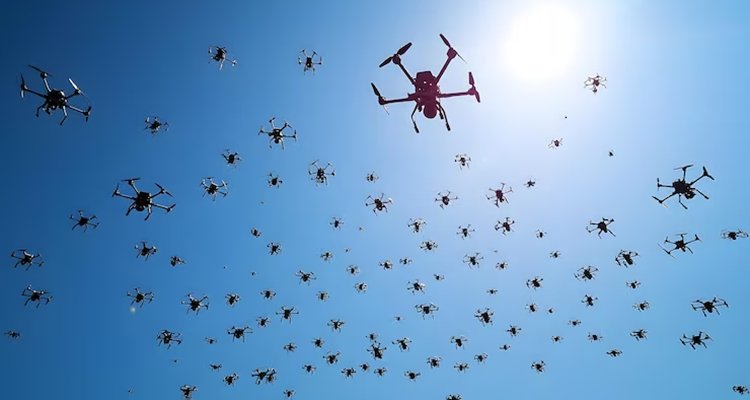
is emphasizing the development of AI-enabled swarm technology, likely to overwhelm advanced air defenses in Taiwan and US military infrastructure in the Indo-Pacific during a conflict. PRC state broadcasting service CCTV released footage on March 25 of the PRC’s “Atlas” drone swarm system conducting training. PRC state-owned tabloid Global Times published a commentary on the same day claiming that each Atlas launch vehicle can deploy 48 drones, and that a single command vehicle can coordinate 96 drones simultaneously. PLA Daily, the PLA’s official newspaper, published a commentary on March 25 citing examples from the armed forces of Ukraine, Russia, the United States, and Israel to suggest that developing AI-enabled autonomous capabilities for unmanned systems is crucial for countering electronic warfare methods that have been effective against drones, particularly on the Ukrainian battlefield.
The PRC appears to be emphasizing AI-enabled swarming technology in its drone development to produce systems that could saturate modern air defense systems during a Taiwan contingency.
The PRC may not yet have achieved the capability that it wants. But its emphasis “on developing drone swarming technology designed to overwhelm sophisticated air and missile defense systems highlights the urgency of developing an IAMD network in Taiwan.” One can’t rest hopes on the possibilities that KMT overtures will soothe the savage beast or that the PRC’s ambitions for its invasion tech will be sabotaged by PRC corruption.
Also see:
C.W. Lemoine: “China Just Revealed Its Drone Swarm Weapon”
A viewer suggests that what the PRC is showing in its recent footage “is on the low end of what is being tested.”