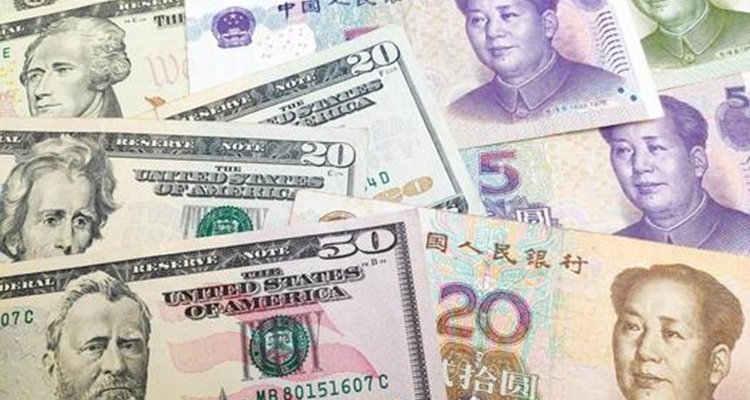
As far back as 2013, there was talk of how the currency of Red China was “on the threshold of becoming the dominant global reserve currency.”
More recently, European Business Magazine asked “Does China want the renminbi to replace the dollar?” and answered “Yes.”
“The” or “a”
Well, there are shades of meaning under the rhetoric here. There is “the” world reserve currency and then there is “a” world reserve currency. “The” implies a level of singularity and domination that does not exist even for America. “A” world reserve currency implies one of many. Every central bank in the world needs a number of currencies to meet demands and obligations. How much it needs varies.
According to the Federal Reserve Bank of Philadelphia, “As of July 2025, the dollar had a roughly 58 percent share of all foreign exchange reserves, whereas the euro held a roughly 20 percent share and the Japanese yen and the pound sterling each had about a 5 percent share.”
Do Eurodollars make up any part of that dollar share of 58%? Because the Bank of International Settlements reckons that there are $13 trillion worth of Eurodollars out there, and they are beyond U.S. control. They are called dollars and count as dollars but have no connection with the U.S. Treasury or the Federal Reserve. They live their entire carefree lives on foreign shores, and by the 1980s the face value of Eurodollars was far surpassing that of U.S. dollars.
“This creates a parallel dollar system with fascinating properties,” writes investor Ben Weiss. “Eurodollar deposits can pay higher interest than U.S. deposits because they avoid Federal Reserve reserve requirements and FDIC insurance assessments. Eurodollar loans can have more flexible terms than U.S. loans because they’re not subject to US banking regulations.”
And any bank in the world could issue a loan denominated in dollars without our say-so, at interest rates set “over there”—creating more dollars, as it were. Supply will be created to meet demand.
Would that appeal to a communist?
If Beijing wanted to create either “the” or “a” world reserve currency, it might want to think first about the danger of the market’s creating its own “Euroyaun” when and where demand appeared.
Although communist China does not register on the Philly Fed’s scorecard for world currencies held by central banks, the Philly Fed has not gotten the full picture. Beijing has, for instance, gained a major role in the BRICS trading bloc: “The renminbi is reportedly already used in 50% of intra-BRICS trade, whereas it made up only 2% in global payments in May 2025.” Neither Fed economists nor U.S. Treasury analysts have much insight into BRICS trade, thus the “reportedly.”
So Communist China’s renminbi (denominated in yuan, jiao and fen) is already a “world reserve currency,” as is the U.S. dollar.
Achieving status quo
But journalists want a horse race to report on, and early last month they whipped a two-year-old statement across the finish line. One Financial Times headline said that “Xi Jinping calls for China’s renminbi to attain global reserve currency status.”
Again, it’s already a global reserve currency. And when you dig into this FT piece (and others like it), you discover that Qiushi, a CCP ideology journal, recently published some few (very few) remarks that Xi made back in 2024 calling for “a powerful currency that can be widely used in international trade, investment and foreign exchange markets, and attain reserve currency status.”
That’s it, the whole program, as of 2024.
CNN sketched the implications in crayon, saying that Xi “outlined plans to turn the renminbi into a global reserve currency. That’s the role the US dollar currently plays—the go-to currency for the vast majority of foreign transactions, making it one of the world’s safest investments.”
At CNN, only one currency can play the role of “a global reserve currency,” and transactions somehow require “safe investments.” But dear CNN, every one of Beijing’s numerous trading partners needs some amount of renminbi. Last year, ¥13 trillion ($1.85 trillion) in trade was settled in the CCP’s yuan.
Again, that’s the trade we track, and we do not track it all. We look at what travels through the SWIFT system but not, for instance, the BRICS system. We don’t count the value of the secret deals Beijing does with sanctioned countries.
The Chinese Communist Party also tries to stimulate demand for renminbi. To spare USD-poor central banks from having to fund trade in scarce dollars, Beijing has signed a total of 40 currency swap agreements with central banks around the world. They can each create up to ¥500 million on demand.
The Game
One silly game that analysts like to play might be called Path to Reserve Currency Status. It consists of enumerating milestones. These can be super-simplistic generalizations. Here’s one set: economic stability and strength, political stability, global trade and investment influence, international confidence and trust, and liquidity and accessibility.
Here’s another set: a sizeable domestic economy, importance of the economy in international trade, size, depth, openness of the financial markets, convertibility of the currency, use of the currency as a currency peg or anchor currency, and stable macroeconomics.
But judging by his skimpy 2024 remarks, Xi has his own criteria: “a powerful currency that can be widely used in international trade, investment and foreign exchange markets.” It sounds like four boxes are ticked but there is really only one, “a powerful currency.”
If “powerful” means “high value,” this would wreck Xi’s export model for growth. Is this communist economic illiteracy in action? Red China is infamous, actually, for weakening its currency in order to secure a trade advantage.
Xi might consider the words of an Australian think tanker, Stephen Kirchner, who writes that the dollar’s role as a reserve currency “does not depend on a ‘strong dollar’ policy.”
Further, “Contrary to popular myth, the US dollar’s role owes very little to its status as a so-called ‘reserve currency.’ The US dollar share of the world’s foreign currency reserves is a symptom, not a cause, of its dominant role.”
A reserve currency emerges from the matrix of supply and demand. Demand for dollars comes not because dollars are strong nor because the dollar has been crowned a reserve currency but simply from demand.
As for Red China, Kirchner says that “China’s RMB is part of a managed exchange rate regime and a system of capital controls and financial repression that is inconsistent with the RMB achieving international status.”
The CCP will never give up enough control over the renminbi to enable it to become a major foreign currency reserve. That wouldn’t be very communist. □
James Roth works for a major defense contractor in Virginia.