Bin Xie at X relays the news that “Chinese are now leaving Iran like crazy. The price of a one-way ticket to Beijing has gone up to 3M yuan ($425,000). What are the Chinese so afraid of? According to a Taiwanese news [story], they have done too many bad things in Iran (such as helping Iranian regime to crack down [on] the protests). Iranian people hate them.”
The reported jump in ticket price is probably inaccurate (tens of thousands of yuan is more likely than hundreds of thousands or a few millions). And the characterization of the Chinese in Iran may be painting with too broad a brush. Probably not all are complicit. But we know, for example, that the Iranian regime has been using made-in-PRC surveillance technology. Chinese technicians probably came with the tech.
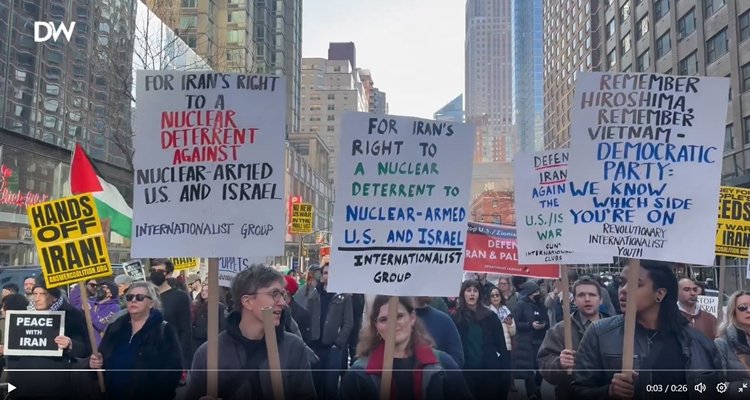
Defending Iran
The video a still of which is shown above is posted at Matt Van Swol’s X account. Swol: “It blows my mind how at any single moment, for any reason, thousands of Leftists can show up instantaneously with foreign flags and signs. Normal people have to rearrange their entire day to show up anywhere…. Are these people just always on call?!!!!”
Yes, always on call. Many are paid agitators working ultimately for people like Neville Roy Singham, billionaire buddy of the Chinese Communist Party. Singham, says The New York Times in an elaborate profile, “is known as a socialist benefactor of far-left causes.”
Replying to Swol on X, DataRepublican comments: “These are all Communists. Not ‘people who are to my left are commies.’ Actual Communists. Just search for CUNY Internationalist Clubs and the other names on those signs.”
Meanwhile, freedom-loving Cato Institute commentators are saying that there has been no threat, no casus belli for the U.S. strikes on Iran—no “event or action that justifies or allegedly justifies a war or conflict” (Merriam-Webster)—neither the past 47 years of the theocratic regime’s actions nor its unrelinquished pursuit of nuclear weapons nor its immediate intentions being deemed sufficient.
John Hoffman: “This was not about preempting an imminent threat.”
Brandan Buck: “…no casus belli….”
Katherine Thompson: “War is not abstract.”
Here we have common ground. Nor are the reasons for the strikes abstract. As for Thompson’s allusions to constitutional arguments against the strikes—though hardly a slam dunk, these are more intelligible than the “no casus belli” baloney.
The future
The Cato scholars stress the uncertainty of the future. But some uncertainties are better than some certainties.
None of the three quoted in the Cato Institute’s feature article articulate any even heavily qualified realization that for many Iranians, the chances of a better life have just dramatically improved. Iranians who do not work for or support the decapitated regime seem to realize it. Nor do any of the three Cato pundits feel it important to acknowledge that an Iran with greatly degraded capabilities is unlikely to be as effective at terrorizing as an Iran with pallets-of-cash-reinforced capabilities.
In its nature and aims, the Iranian state that comes next may be the same, better, or worse than the pre-strike state. Worse how?