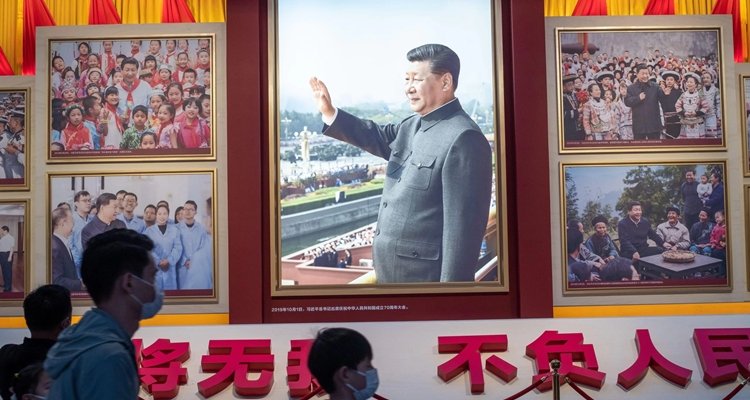
A recent Index on Censorship post takes for granted what has been a matter of dispute: “Journalists as well as generals have been purged—only Xi is safe in China today” (February 9, 2026).
The controversial assumption is that Xi is safe. Some longtime interpreters of the CCP’s often opaque internal politics believe that Xi has an iron grip on the institutions of the Chinese Communist Party and state and that his position is unassailable. Others believe that he has been on shaky ground for at least the last year and a half or so, ground that he has made even shakier by arresting the PLA’s top general, Zhang Youxia, and Zhang ally Liu Zhenli. In recent live streams posted at her channel, Lei of Lei’s Real Talk has been making the latter case. Many who take the opposite view don’t even acknowledge that there’s a debate.
But the prospects for Xi Jinping are not the main point of Jemimah Steinfeld’s Index piece. What he wants to stress is that journalists, not just generals, are in danger in Xi’s China.
The recent oustings show that the best way to stay out of trouble is to not align with, or investigate, those at the top….
There’s of course nothing wrong with stamping out corruption if and when it exists and if done with due process. It’s just that a genuine desire to rid the country of double-dealings rings hollow in Xi’s China, as the arrests of two journalists earlier this month remind us. On 1 February, Liu Hu and Wu Yingjiao were detained. Two days earlier they’d published an article on Hu’s public WeChat account alleging corruption by Sichuan’s county party secretary. The article is now offline. The pair have been accused of “making false accusations” and conducting “illegal business operations”….
They’re the kind of journalists that would be exalted in ordinary circumstances, except China is no ordinary place. It holds the global title of number one jailer of journalists of any country and goes big on publicising the cases of some to scare others. The repeated arrests of citizen journalist Zhang Zhan and the five-year sentencing of Sophia Huang Xueqin (a former Index award–winner) are two examples. Even a quirk—the fact that local TV in China is often full of stories exposing government corruption—serves a purpose. As the scholar Dan Chen outlined in the pages of Index, it’s a cunning way to entrench power….
Wu and Liu flew too close to the sun, and for totally different reasons so too did the military men. The best way to stay out of trouble in China is to not align with, or investigate, those at the top.
So journalists are not safe in modern China. Comedians are not safe. Tibetans, Uyghurs, Hongkongers, and practitioners of Falun Gong are not safe. Nobody in China is safe. But some are in more danger than others.