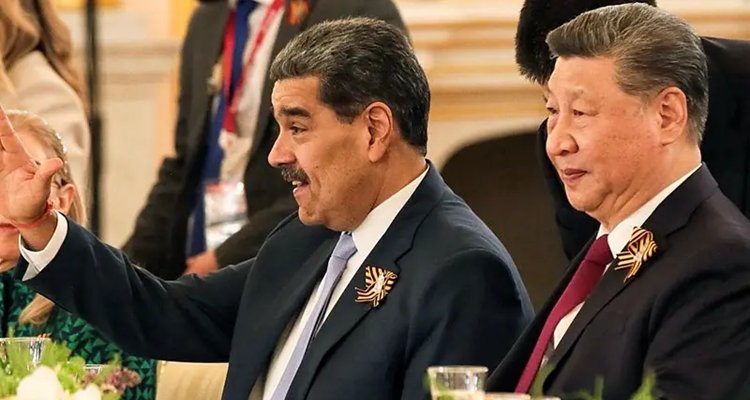
Hours before being snatched, Venezuelan strongman Nicolas Maduro praised his government’s relations with Red China as a “perfect union to the test at all times, always victorious and at full speed.” Last year, his counterpart, Xi Jinping, said that Beijing “will, as always, firmly support Venezuela in safeguarding state sovereignty, national dignity and social stability.”
On January 3, 2026, Mr. and Mrs. Maduro were moved at full speed to a New York jail, and Beijing’s response was the equivalent of a strongly worded letter to the editor: “Such hegemonic acts of the U.S. seriously violate international law and Venezuela’s sovereignty, and threaten peace and security in Latin America,” said their foreign ministry. Shocking perhaps because, as the Washington Post reports, “Beijing has been the regime’s most influential global ally.”
Really? Ally?
Not ally
All the world now sees that relations with Beijing are economic only, without also a security guarantee real, implied or imagined.
In fact, in the western hemisphere at least, cozy relations with communist China are likely to reduce national security in proportion to how much they irritate the United States. (Remember the Panama matter of early 2025?)
Pundits now struggle to understand the fallout. The power politics part of it is clear, but the economic effects are still developing.
For instance, one theme emerging since the Maduro operation is that lack of access to Venezuelan oil will damage, perhaps even cripple, Red China’s economy. This was the assertion energetically delivered during the first hour of Vince Coglianese national radio talk program on January 7.
But Time, citing Reuters, reports that “Venezuela’s oil shipments to China, its main buyer, averaged over 600,000 barrels per day in December 2025, constituting about 4% of China’s total oil imports.” Is a 4% cut a major setback, especially if crude of the same type and grade is available from Canada and Mexico?
Moreover, President Trump has said, “I have a very good relationship with [Red China’s President] Xi, and there’s not going to be a problem. They’re going to get oil.”
Debt for oil
Here we may have a problem with Time’s use of “buyer” (“China, its main buyer”) just as we had with the Washington Post’s “ally.” Is Beijing really a buyer of Venezuelan oil? Or has the oil been provided in lieu of loan repayments to the China Development Bank?
“Beyond The Horizon, an independent think-tank in Belgium, estimated in December 2025 that Venezuela still has some US$12 billion outstanding debts with China as part of an oil-for-loans programme by China Development Bank,” the Straits Times reports.
Also: “Since 2016, China has largely stopped issuing new loans to Venezuela, focusing instead on restructuring existing debt.”
Part of that restructuring seems to entail commitments to deliver oil.
By the way, the scope of Venezuelan debt transcends the oil-for-loans program. Headline: “China’s $100 billion in loans at stake in Venezuela after US captures Maduro.”
But back to oil.
Shandong province has independent refineries, called teapots, tooled specifically to refine Venezuelan heavy oil (“Merey 16”). Forbes reports that its “independent refiners configured coking units specifically for Venezuelan heavy crude, a grade trading at deep discounts because Western buyers can’t touch it.”
In other words, the teapots have been running an arbitrage business whereby they take sanctioned, smuggled, discounted Venezuela crude provided by way of agreements between Beijing and Caracas, refine it, and sell it at global market prices. Communist Chinese “have essentially turned American sanctions into a competitive advantage.”
And these Venezuelan imports are going into international sales, not local use.
Well, no more. Depending on the meaning of President Trump’s “They’re going to get oil,” Beijing’s supplies and profits may be in trouble. What oil will Beijing get, Merey 16—or something else? And will the oil they get count against Venezuelan debts, or has that sweet deal been superseded?
What’s next
Forbes posits three scenarios for Red China:
Scenario A (45%): Pragmatic accommodation. Beijing quietly engages transitional government, negotiates 40-50 cents on the dollar, redirects teapot [independent refinery] demand to Canadian and Iraqi grades. Financial loss absorbed to preserve broader trading relationships.
Scenario B (35%): Extended standoff. Beijing refuses recognition, teapots attempt continued sourcing despite vessel designations. U.S. escalates to secondary sanctions on Chinese banks processing Venezuelan-origin payments. Teapot margins collapse within six to nine months.
Scenario C (20%): Venezuelan collapse. Transitional government fails, military factions fragment, production drops below 600,000 bpd. Neither Chinese debt recovery nor American reconstruction succeeds. Heavy sour [Merey 16] exits global market for years.
If Red China has to write down its loans, it won’t be a crisis. If, the worst case, the teapots have to close down, it won’t be a national setback. The bigger impact will be on international relations, with America’s neighbors having to reconsider their entanglements with Beijing. □
James Roth works for a major defense contractor in Virginia.