In 1984, Steven Mosher, denied a PhD for his work on rural China, published a book on the subject that Stanford University officials thought was too hot to handle.
The book was Broken Earth: The Rural Chinese, which told the story of ordinary people living under communist rule. Part of the story was how women were being pressured to submit to strict birth control, often including sterilization and compulsory abortion, as a means of population control.
As the 21st century progressed, the problem in China was no longer (if it ever was) overpopulation but declining population, in response to which the Chinese Communist Party has been encouraging marriage and child-bearing. There is still for some reason a limit of three children per family (replacing earlier one-child and two-child limits). But this new limit, announced in 2021, does not seem to be strictly enforced.
The Chinese government continues to engage in coercive birth control. The focus has changed, though, with only particular subpopulations being especially targeted: disfavored groups, like the Uyghurs of Xinjiang, that the Chinese Communist Party wants to see less of (Zeteo, December 9, 2025).
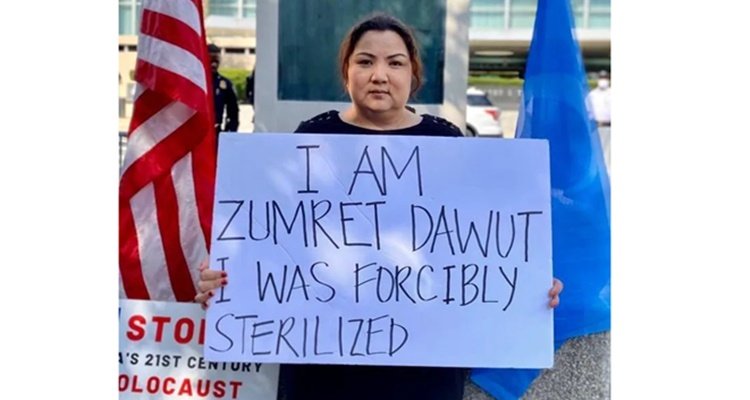
Zumrat Dawut, a Uyghur mother of three from China’s Xinjiang region, has spent much of her adult life haunted by the Chinese government’s repression of her community. After enduring months in a state-run concentration camp, she emerged only to face another trauma: the loss of her ability to bear children.
Four months after she was released from the concentration camp in the summer of 2018, she was told she would be forcefully sterilized….
Since as early as 2016, the Chinese government has been detaining Uyghurs in concentration camps it calls “vocational-education and training centers.” According to Human Rights Watch, Uyghurs were subjected to indoctrination, torture, and forced medical procedures. One hallmark of the government’s assault on Uyghurs is the prevention of births through forced sterilizations, forced abortions, and forced birth control, according to a UN report….
“For Uyghurs who have that predominantly Muslim identity, but also a very distinct culture and language, that is very difficult for the Chinese state to control,” said Julie Millsap, government relations manager for the nonprofit No Business with Genocide. “Anything that can’t be controlled by the state is viewed as a threat.”
Fear of being sent to the camps is one of the reasons that Uyghur women have submitted to such birth-control methods as abortions, intra-uterine devices, and sterilization.
“Since a sweeping crackdown starting in late 2016 transformed Xinjiang into a draconian police state, witness accounts of intrusive state interference into reproductive autonomy have become ubiquitous,” according to a 2020 report by China scholar Adrian Zenz.
The claims are “baseless,” says the Chinese government.
Women who practice Falun Gong and Tibetan women have also been subjected to forced abortions.