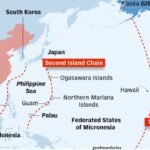
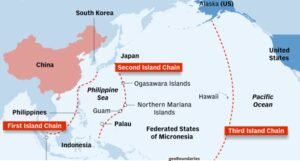
“No one imagined twenty years ago that China would send warships to the Australian Pacific coast,” says Steven Yates, a researcher with the Heritage Foundation, in an interview with The Chosun Daily, a major South Korean newspaper. “Today, it conducts hundreds of blockade drills around Taiwan and harasses South Korea, making it natural to question the role of the South Korea-U.S. alliance beyond just the North Korean issue” (November 17, 2025).
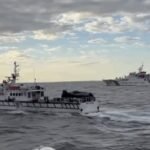
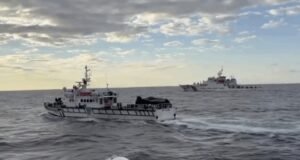
Yates thinks that unless the South Koreans do more to prevent it, the waters near their country will turn into what the South China Sea is today: a gray-war zone. Within the boundaries of the Philippines’s exclusive economic zone, China Coast Guard vessels continually harass, water-cannon, and smash into Philippine vessels—all in order to protect China’s territorial rights, says China.
China is attempting to turn the West Sea (Yellow Sea) into an internal sea by installing structures converted from decommissioned drilling rigs in the region, a strategic hub for economic, military, and diplomatic interests. The installation of fixed structures aims to strengthen maritime dominance and restrict navigation access for South Korean vessels—a tactic mirroring its strategy of drawing the nine-dash line in the South China Sea to escalate disputes….
Recently, the Center for Strategic and International Studies, a Washington, D.C.-based think tank, revealed that in September, three Chinese vessels pursued and pressured a South Korean survey ship for 15 hours….
“I urge South Koreans worried about maritime sovereignty to deeply study what has unfolded in the South China Sea since the early 2000s,” [said Yates].
China drew the nine-dash line—a virtual boundary—in the South China Sea, claiming 90% of the area as its territory, provoking strong backlash from neighboring countries like Vietnam and the Philippines. Though the Permanent Court of Arbitration ruled in 2016 that the claims lacked legal basis, China has ignored the decision.
Yates believes that if South Korea fails to “take serious political, economic, diplomatic, and military measures now, it will end up having to respond belatedly like the Philippines, which is struggling to counter China’s commando-style operations—under the guise of ‘fishing vessels’—that ram into its coast guard.”
With respect to Japanese Prime Minister Takaichi’s recent statement that Japan would likely intervene to help Taiwan if it were attacked by the People’s Republic of China, Yates is supportive. “I call this common sense. It is essential for rational leaders in the international community to voice their stance like Takaichi.”
That would include the leaders of South Korea.
“South Korea’s economy and its very survival depend significantly on whether international norms like freedom of navigation are upheld in this region…. Maintaining the status quo in the Taiwan Strait is a critical national interest for South Korea. While I respect the South Korean government’s desire to avoid conflict…‘avoiding war’ can never be a strategy or policy…. South Korea must deeply consider whether it has the luxury of being cautious on the Taiwan issue.”