An otherwise diligent New York Times expose of how the Chinese Communist Party works to flip Big Apple elections in its favor may be marred by a grave omission.
The lengthy report, published last summer, details how China’s consulate in Manhattan “has mobilized community groups to defeat candidates who don’t fall in line with the authoritarian state.” The several authors write that the consulate does this through social clubs that “have quietly foiled the careers of politicians who opposed China’s authoritarian government while backing others who supported policies of the country’s ruling Communist Party” (August 25, 2025).
The groups are mostly “hometown associations” of people hailing from the same town or province in China. Some have been around for more than a century, while dozens of others have sprung up over the past decade. Like other heritage clubs in a city of immigrants, they welcome newcomers, organize parades and foster social connections.
But many hometown associations have become useful tools of China’s consulate in midtown Manhattan, according to dozens of group members, politicians and former prosecutors. Some group leaders have family or business in China and fear the consequences of bucking its authority. Consulate officials have enlisted them to intimidate politicians who support Taiwan or cross Beijing’s other red lines. In one case, a Chinese intelligence agent and several hometown leaders targeted the same candidate.
This meddling may seem modest, involving politicians who are unlikely to affect international policy. But China is determined to quash dissent in its diaspora before it spreads back home, said Audrye Wong, a fellow at the American Enterprise Institute who studies Chinese influence.
Beijing is also making a longer bet, she said: “You never know which politician might eventually run for Congress at the national level, or become a presidential candidate.”
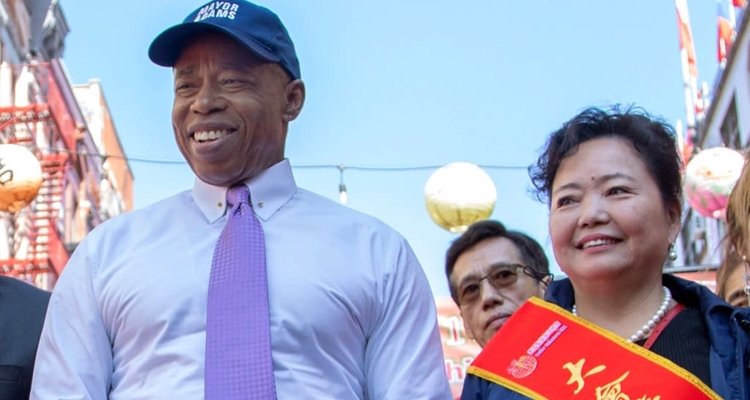
Among the candidates who have been backed by the CCP-dominated hometown associations is Mayor Eric Adams (shown above with former aide Winnie Greco). Adams, one of the area officials who have regularly attended events involving the Chinese government, reportedly has “ties to alleged proxies for the Chinese regime.” Although he turned out to be a bad bet, the Party’s involvement has been more successful in other New York City elections. (I could find no information on whether the CCP or its local partners acted on behalf of Mamdani at any point during this year’s mayoral contest. But Party officials cannot be too upset that the most communist of the candidates will now be inhabiting Gracie Mansion.)
After the Times article hit the streets, New York Post columnist Michael Goodwin found much to praise in this “epic examination of how China is influencing New York City elections.” But something is missing, he said (New York Post, August 26, 2025).
If the groups [the hometown associations] are engaged in illegal political activities, why does the Times not even question if the voters it says are deciding these narrow elections are American citizens, and thus legally permitted to vote?
After all, to become a citizen and gain the right to vote means going through the naturalization process, which generally means holding a green card for at least three years….
Yet if these voters are still swearing allegiance to China in other settings, as the Times demonstrates, they have not fulfilled a basic legal requirement of citizenship, and their votes might be illegal.
Goodwin emailed one of the authors of the Times story to inquire about their apparent neglect of this question. The response: crickets, “leaving me with the suspicion that there is another huge dimension to this election scandal.”