This post is about how the People’s Republic of China probably assisted a Russian attack on Ukraine; PLA training in a “mock Taipei”; Taiwanese citizens who are missing or detained in the PRC; prospects that the Republic of China will work with Central and Eastern European countries on defense matters; the Kuomintang versus increases in ROC defense spending; ROC President Lai’s appeal to President Trump; and the pro-Taiwan views of Japan’s Sanae Takaichi.
These are among the stories covered in the latest update produced by the the Institute for the Study of War and the American Enterprise Institute in their latest China-Taiwan Weekly Update (October 10, 2025).
Targeting Ukraine. “The PRC may have provided targeting intelligence to support a recent, large-scale Russian strike on Ukraine.” According to Ukrainian intelligence, two PRC satellites were flying over western Ukraine during a Russian attack on Lviv, in western Ukraine. Ukraine’s intelligence service “stated that the PRC likely used the Yaogan satellites to provide targeting support for the Russian strike on Lviv.”
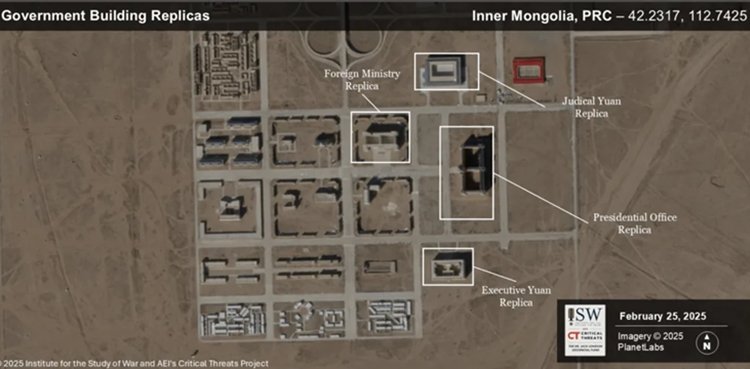
Practicing for invasion. “The PRC has reportedly expanded one of its ‘mock Taipei’ training grounds in Inner Mongolia. PLA training using a model of Taipei signals its increasing commitment to realism in its military exercises.” Using replicas of government offices, one thing that PLA soldiers seem to be practicing is how to kill ROC leaders.
Missing or detained. “The number of Taiwanese citizens reported missing, detained, or under travel restrictions in the PRC in 2025 has nearly tripled since 2024.” There were 55 such cases reported in 2024; so far, in 2025, 157 such cases have been reported.
Interested in cooperating on defense. The attendance of the Warsaw Security Forum by senior Taiwanese officials, including Taiwanese Foreign Affairs Minister Lin Chia-lung, “first in his position to attend the forum,” suggests “growing Taiwanese and Polish interest in security cooperation with one another.”
Kuomintang legislators on the Foreign and Defense Affairs Committee of the Legislative Yuan “could stifle President William Lai Ching-te’s efforts to increase defense spending.” The news doesn’t exactly veer from what the reporting has been since Lai won the presidential election in January 2024. If a current “record high” special defense budget is approved by the Executive Yuan and proceeds to the Legislative Yuan, the Foreign and Defense Affairs Committee may block its passage and “impair Taiwan’s ability to enhance its military capabilities.”
ROC President Lai Ching-te “called upon US President Donald Trump to deter a PRC invasion of Taiwan” and on a U.S. podcast “[said that] Trump should win a Nobel Peace Prize if he successfully deters” an invasion of Taiwan. In response, the PRC Taiwan Affairs Office blasted Lai for “ ‘fawning’ over foreign powers.” The PRC “frequently accuses the DPP of reliance on ‘foreign powers’ and criticizes Lai as a provocateur.” But according to the Update, the Taiwan Affairs Office’s latest statements slamming Lai “mark a rhetorical escalation from previous comments.”
Sanae Takaichi. The new president of Japan’s ruling Liberal Democratic Party, Sanae Takaichi, needs to secure a majority in the Japanese Diet after it reconvenes on October 15 in order to become the country’s first female prime minister. The Weekly Update notes that she has “long called for Japan to build closer relations with Taiwan and opposes unilateral changes to the status quo in the Taiwan Strait through force or coercion” and that she favors a “quasi-security alliance” with Taiwan and others. PRC media call her “anti-China.”
“It is unlikely that Takaichi will make significant improvements to Japan-PRC relations if elected as prime minister,” the Update authors say. But what do they mean by “significant improvements”? A “better” relationship with the Chinese government is actually worse if it entails more appeasement and more guard-lowering, even if the PRC propagandists say nice things about you as a result.