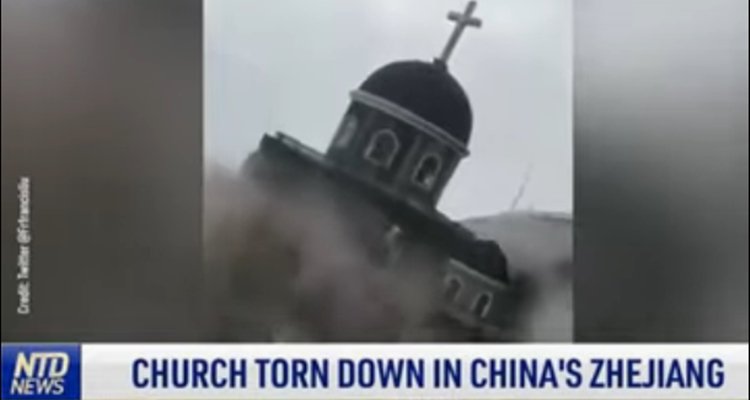
It’s hard to say whether these new CCP regulations are requiring anything of religious practice that hasn’t already long been in force in the People’s Republic of China.
The Chinese Communist Party wants all religious expression to be tantamount to Party propaganda. The CCP harasses priests, pastors, monks, and other practitioners of religion or spiritual disciplines who try to function independently. Many end up in jail. What new power to repress do Chinese police and other authorities require in order to proceed with their terrorizing of clergy and congregations and destruction of mosques and churches?
Bull and hammer
Perhaps the latest round of regulations reinforce all this and tighten the noose. Maybe the focus on online speech is a new twist. Bitter Winter reports that “the latest regulatory dispatch from the National Religious Affairs Administration—issued with the bureaucratic solemnity of a papal bull and the subtlety of a sledgehammer—takes the digital leash on clerical personnel to a new level of precision” (“Holy Firewalls: China’s New Rules for Online Clergy Conduct,” September 18, 2025).
Bitter Winter translates China’s new rules into English.
Among other things, Article 1 of the dicta says that the purpose of the regulations is to “maintain order in the Internet religious field.”
Article 2 says: “Religious clergy engaging in online activities should love the motherland, support the leadership of the Chinese Communist Party, uphold the socialist system, follow national laws and regulations, and adhere to relevant provisions on managing religious affairs. They should observe social morality, maintain public order and good customs, set an example in complying with the ‘Self-Discipline Convention on Civilized Internet Use,’ follow religious rules and regulations, and accept government supervision and social oversight.”
Article 3 says: “Religious clergy should uphold the core socialist values, follow the principle of independence and self-management of our country’s religions, adhere to the Sinicization of our country’s religions, actively guide religions to adapt to socialist society, and promote religious, social, and ethnic harmony when using the Internet.”
There’s also talk of a mandatory “Internet Religious Information Services License.”
Independence
We get the idea. But what are we to make of the exhortation to “follow the principle of independence and self-management of our country’s religions”?
The “independence” being alluded to must be that of the CCP, which regards itself as justified in managing all practice of religion in China itself (“self-managing”) independently of whatever religious authorities outside of China may say. So if some priest in Paris or Binghamton says “We worship Jesus Christ, not Xi Jinping” or “You shouldn’t be throwing people in jail for practicing their religion,” the CCP will ignore such statements in obedience to what it calls “independence” and “self-management.”
Whatever the exact meaning of these words as used by China’s National Religious Affairs Administration, they definitely and obviously do not mean that people in China are now free to practice religion independently of the Chinese Communist Party.