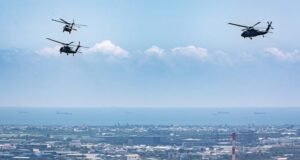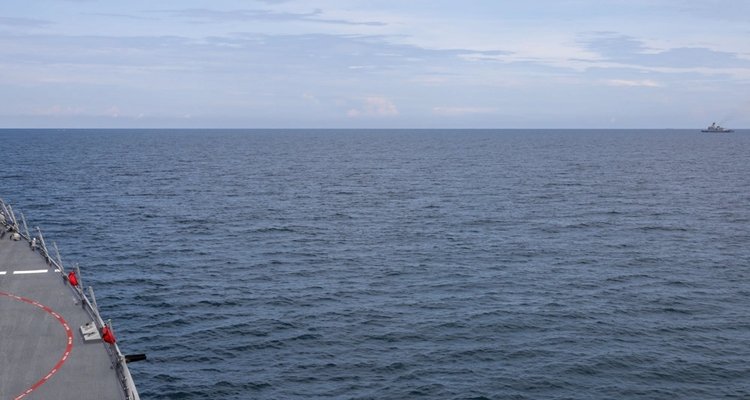
The respective forces conducted either defense drills or multilateral maritime cooperative activity (MCA), as the U.S. Indo-Pacific Command puts it (September 13, 2025). The military must have its special terms and acronyms. In any case, the September 11 to 13 maneuvers demonstrated “collective commitment to strengthen regional and international cooperation in support of a free and open Indo-Pacific.”
These combined maritime capabilities build upon previous MCAs and our continuous operations together, which strengthen the interoperability of our armed and defense forces doctrines, tactics, techniques, and procedures.
MCAs are conducted in a manner consistent with international law and with due regard to the safety, navigational rights, and freedoms of all nations….
The U.S., along with our allies and partners, upholds the right to freedom of navigation and overflight and other lawful uses of the sea and international airspace, as well as respect to the maritime rights under international law.
U.S. 7th Fleet is the U.S. Navy’s largest forward-deployed numbered fleet and routinely interacts and operates with allies and partners in preserving a free and open Indo-Pacific region.
Nothing in the release refers specifically to standing up to the People’s Republic of China, whose coast guard and other vessels continuously invade the Philippine exclusive economic zone to engage in continuous harassment of Philippine vessels. But I guess the idea is that everybody knows the identity of the big country to the left on the map that has been causing all the trouble.
A shared responsibility
In a more recent article, one Richard Javad Heydarian, Professorial Chairholder in Geopolitics, Polytechnic University of the Philippines, suggests that even as the Philippines is “significantly upgrading defense ties with Australia and other Western partners amid growing tensions with China in the South China Sea, underscored by large joint exercises and plans for expanded troop access…both Manila and Beijing share responsibility to de-escalate tensions and pursue diplomatic solutions…” (September 19, 2025).
Despite the professor’s expertise in geopolitics, he is unable to penetrate the mysteries of “the latest tussle in the South China Sea,” which “is shrouded in contradictory statements.” The Chinese government says one thing about what happened, but the Philippine government says another. Baffling!
On the Philippine side, “officials claim that the incident demonstrates China’s increased risk appetite, including the will to directly assault Philippine vessels.” How can we know who is telling the truth here?
Well, anyway, “What’s clear…is that the South China Sea disputes are entering a dangerous phase…. Moving forward, the two countries should pursue [confidence]-building measures…. Both sides should also refrain from deploying warships and/or conducting massive wargames in the area, thus limiting any maritime contestation to their civilian coast guard forces.”
Heydarian would also like Manila to “calibrate its language on the Taiwan issue” in light of Beijing’s sensitivity, and to refrain from “openly declaring any potential involvement in any military contingency against China.”
Everybody should have a PhD in geopolitics.