“American universities should never be a pipeline for the Chinese Communist Party’s military ambitions,” says Congressman John Moolenaar, chairman of the Select Committee on the Chinese Communist Party (September x, 2025).
A new report that “reveals alarming new details” about university entanglements with the totalitarian dictatorship, “Joint Institutes, Divided Loyalties,” has been released by the committees led by Moolenaar and by Congressman Tim Walberg, who chairs the Committee on Education and the Workforce.
Among the partnerships it discusses:
● Three joint degree programs between U.S. universities and China’s Seven Sons of National Defense—universities hand-picked by the CCP to propel China’s military and defense research forward.
● A partnership in submarine engineering research between the University of Houston and Dalian Maritime University, which is supervised by a Chinese defense-focused government agency and partners with Chinese defense conglomerates on engineering research.
● A dual degree in aircraft power engineering between [Southern Illinois University Carbondale and] Shenyang Aerospace University, which is supervised by blacklisted Chinese military company the Aviation Industry Corporation of China and the developer of China’s fifth-generation stealth fighter.
● A joint program in mechanical design, manufacturing, and automation between North China Institute of Aerospace Engineering—a university controlled by blacklisted Chinese military companies that produce China’s Long March Rockets and other missiles—and Saint Martin’s University in Washington state.
What were the administrators who okayed these and many other such collaborations thinking? What about the researchers who participate in them? Do they believe that it’s a good idea to strengthen the ability of the People’s Republic of China to attack the Republic of China, the Philippines, Japan—or the United States?
“The overseas structure magnifies exposure—even when U.S. presence is minimal,” the report notes. “Universities often downplay the U.S. national security threat posed by joint institutes and other academic partnerships by citing low numbers of Chinese students on their U.S. campuses. But that misses the point. Most joint institutes operate primarily in China, not the United States. They deliver U.S.-branded programs to large cohorts of Chinese students, often in defense-relevant fields, under PRC law and in PRC-run facilities—without meaningful U.S. oversight.”
On the quad
After releasing an earlier report on the same subject, “CCP on the Quad,” “the Committees issued formal oversight letters to a subset of these programs. We identified a subset of 21 of the highest-risk joint institutes out of the thousands in operation, and we launched direct inquiries into nine…. Faced with these facts, these universities closed their Joint Institutes….”
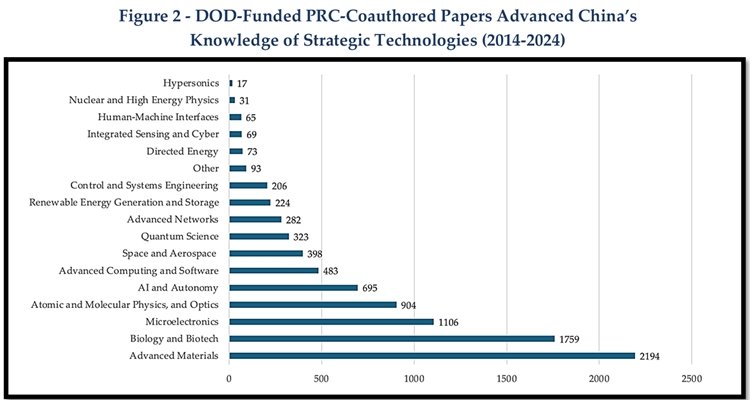
But many U.S. universities “have remained silent, collecting millions from Chinese students while helping Beijing advance its military and technological goals. The arrangement is perverse: American taxpayers fund research that strengthens our foremost adversary.”
Legislation supported by Moolenaar and Walberg, the SAFE Research Act, would prohibit giving federal or specifically DOD funding to researchers and universities that collaborate with “foreign adversary-controlled entities that pose a national security risk.” It would also require greater disclosure of collaborations or affiliations with “foreign adversary entities.” The SAFE Research Act passed the House on September 10.
Also see:
Select Committee on the CCP and the Committee on Education and the Workforce: “Joint Institutes, Divided Loyalties: How the Chinese Communist Party Exploits U.S. University Partnerships to Empower China’s Military and Repression”