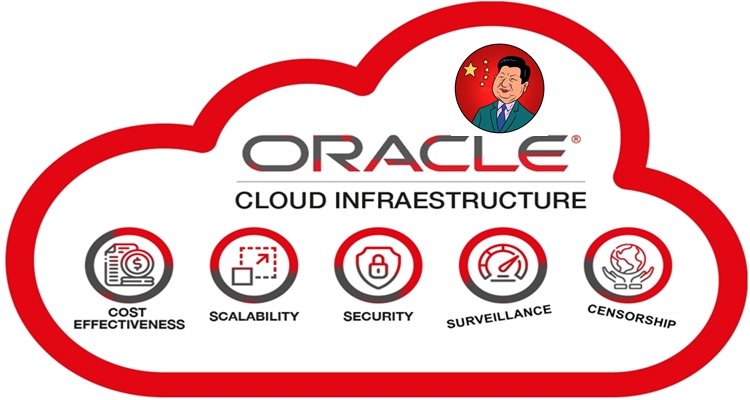
Luke Hogg’s advice about how the U.S. government should cope with technology companies that help or might help tyrannical foreign governments to oppress their people is weak.
Most of his article on how “Oracle is Powering China’s Surveillance State” strongly indicts the firm for its years of eager collusion. But here is the last line: “The message from policymakers to firms like Oracle should be unequivocal: you cannot build the digital scaffolding of Chinese tyranny with one hand and expect American taxpayers to pay you with the other” (National Interest, September 4, 2025).
Obviously, though, the U.S. should prohibit technology firms outright from working to facilitate the repression of the PRC, Russia, North Korea, Myanmar, etc. The federal government should not confine itself to withdrawing subsidies or contracts from firms that do so facilitate. And the penalties for violating the prohibition should be severe.
A quintessential case
A U.S. firm may help equip a totalitarian state without knowing that it is doing so. There’s a big difference between producing widgets that after being sold and resold eventually end up being used to craft tools of oppression and, on the other hand, directly working with an oppressive government to craft tools of oppression. Oracle was so clearly operating on the specific and unambiguous side of things that the higher-ups at the company could not possibly have been confused about what they were doing.
Oracle, a titan of enterprise software, has a long history of engagement with Beijing and is perhaps the quintessential case of a US tech firm entrenched in China’s public-sector IT infrastructure. By the mid-2010s, Oracle’s database and enterprise management tools were ubiquitous across Chinese government agencies and state-owned enterprises, forming a critical backbone of official IT systems. An online portal run by China’s State Council even touted that Oracle databases power e-government services at all levels. In effect, Oracle became woven into the fabric of China’s governance networks; networks that are being leveraged for surveillance and censorship.
This entanglement was no accident. Oracle aggressively courted Chinese state clients with tools and expertise that fit neatly into the Communist Party’s surveillance ambitions. As Chinese authorities invested heavily in “smart city” surveillance and predictive policing programs, Oracle positioned itself as a ready partner. The company marketed its advanced data analytics platforms, such as the Oracle Endeca Information Discovery system, explicitly as law enforcement solutions for China’s police. Oracle representatives in Beijing even held up American examples to sell their products: in one presentation, they highlighted how Chicago police used Oracle software to monitor protesters, implicitly suggesting Chinese security forces could do the same.
Oracle stayed behind the scenes when it could, working through other companies within Red China. In this way it could “enable surveillance while keeping a low profile. Local resellers and systems integrators with government ties funneled Oracle tech into state security projects, effectively letting Oracle power China’s surveillance state from the shadows.”
At least a year
Oracle kept it up even after nobody directing and monitoring the work could possibly have pretended not to know how the technology was being used. There was no “Omigod, what have we done” and lurch to extricate the firm from the People’s Republic.
“Even as Beijing’s repression of Uyghur Muslims in Xinjiang provoked worldwide condemnation, Oracle kept doing business with the Xinjiang Public Security Bureau, the very agency orchestrating mass internments and pervasive digital surveillance. Internal documents and presentations from Oracle in that period reveal that the company’s data analytics and security software were used by Xinjiang police. In fact, for at least a year after the world learned of ‘re-education’ camps and draconian controls in Xinjiang, Oracle was still providing tools that supercharged the authorities’ ability to monitor and classify the region’s oppressed minorities.”
Moreover, since the PRC’s surveillance state “is a cornerstone of its domestic control and a key feature of its influence on other authoritarian-leaning governments. By helping to refine that machinery, Oracle may be bolstering a system that ultimately threatens US interests and global human rights.”
Hogg says that “to Oracle’s credit,” the company refrained from doing the very worst done by some other companies, like “form joint ventures with China’s military-linked companies or hand over source code to the People’s Liberation Army.” But he immediately adds that “such distinctions ring hollow when weighed against Oracle’s overall posture [conduct] in China.” They do.