The Chinese government is continuing its gray-zone war on Philippine vessels performing tasks within the Philippine exclusive economic zone, and water cannons continue to be one of China’s preferred gray-zone weapons (Newsweek, June 23, 2025).
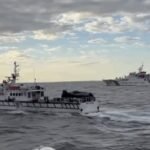
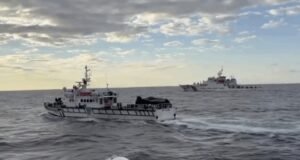
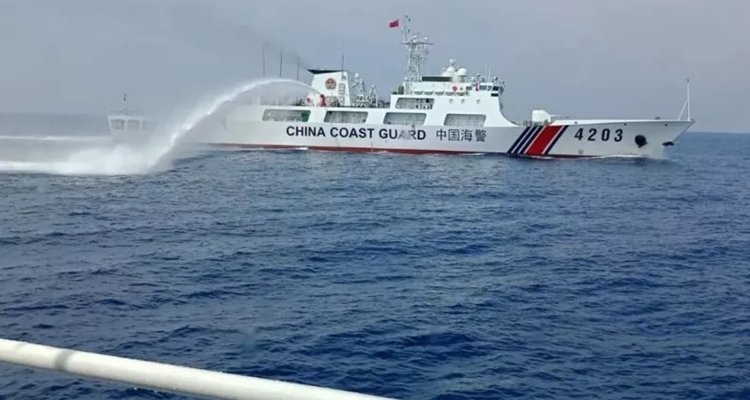
The Philippines has released footage showing the Chinese coast guard deploying water cannons to drive away a fisheries bureau vessel operating within the Philippines’ exclusive economic zone….
On Friday morning, four vessels from the Philippine Bureau of Fisheries and Aquatic Resources arrived at Scarborough Shoal—a rich fishing ground—to distribute fuel subsidies to more than 20 local fishing boats, Philippine coast guard spokesperson Jay Tarriela wrote on X (formerly Twitter).
At around 10 a.m., Chinese coast guard ships moved in and began conducting “aggressive maneuvers,” Tarriela said.
One Chinese vessel came within 16 yards of the Philippine ship BRP Datu Taradapit, about 18 miles southwest of Scarborough Shoal, carrying out blocking maneuvers and firing its water cannon, at one point striking the port quarter of the Philippine vessel, according to Tarriela.
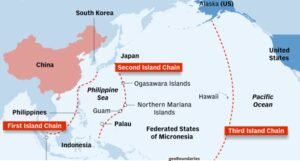
In other Chinese-incursion news, China has been deploying maritime structures—an “integrated management platform…and two aquaculture cages” in a Provisional Measures Zone (PMZ) provisionally shared by China and South Korea. China deployed the structures “without prior consultation with the South Korean government” (Beyond Parallel, May 30, 2025).
The South Korean government has had no luck asking China to remove the structures. China has also declared no-sail regions in the PMZ, and it has been deploying buoys in the Yellow Sea since 2018. BP reports that in February 2025, “a South Korean research vessel’s effort to survey the Chinese structures installed within the PMZ was blocked by the Chinese coast guard.”
So the PMZ is not really a “shared” zone, then, not really a zone in which agreed-upon limits on activity are scrupulously observed by the contesting parties until such time as their competing claims can be resolved.
Normalizing
Earlier this year, VOA News observed that China was “normalizing its claims to maritime zone shared with South Korea” (January 23, 2025).
The PMZ had been established some years earlier, in 2001, “to manage the overlapping claims to the area. Building any kind of facility and conducting activities unrelated to fishing are banned in the area until the dispute is settled.”
“It is likely that these recent actions are tied to a gray zone strategy that slowly encroaches on this area in ways that over the long-term reinforces their claims,” said Terence Roehrig, an Asia-Pacific security expert and lecturer at the University of Wisconsin-Madison.
“The goal of a gray zone strategy is to slowly force the target state to accept a new normal in the area. Seoul must ensure that does not happen by continuing to assert its position and insist that the delimitation of these waters be settled through negotiation….
“China views the Yellow Sea as a crucial area for its security and potential gateway into the Chinese heartland. It is likely that eventually, these structures may have some military use.”
If we ignore the tentativeness, Roehrig makes sense up until the part where he suggests that something can be settled with China by negotiation when China wants something that the other party doesn’t want to give.
It’s possible. It is metaphysically possible that the People’s Republic of China, in some time and place, will negotiate in good faith with one of its targets; the laws of the universe don’t prohibit it. But this is not the record so far. The record so far is that the Chinese government routinely says anything in order to be in a better position to do the opposite of what it says. Don’t trust China.