Almost simultaneously, we hear, on the one hand, that Donald Trump “has urged allies, as well as China, to send warships to help get oil flowing again through the Strait of Hormuz as he threatened to intensify attacks on Iran’s crucial Kharg Island fuel depot and port complex” (Australian Financial Review, March 15, 2026); on the other hand, that Iran is bragging about the help it is getting from Russia and China (New York Post, March 14, 2026).
It’s the same China being talked about in each case, the People’s Republic of China.
Financial Review:
“We have already destroyed 100% of Iran’s Military capability, but it’s easy for them to send a drone or two, drop a mine, or deliver a close range missile somewhere along, or in, this Waterway, no matter how badly defeated they are,” Trump posted on his Truth Social media platform on Saturday night….
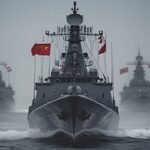
“Hopefully China, France, Japan, South Korea, the UK, and others that are affected by this artificial constraint will send Ships to the area so that the Hormuz Strait will no longer be a threat by a Nation that has been totally decapitated,” he wrote….
“In the meantime, the United States will be bombing the hell out of the shoreline, and continually shooting Iranian Boats and Ships out of the water,” he posted….
Iran has allowed some Chinese and Russian ships through the strait.
The New York Post:
The two American adversaries [Russia and China] have been accused of providing the Islamic Republic with intelligence regarding the locations of US military assets during Operation Epic Fury.
The foreign minister revealed China’s involvement in the war just days after he said that Russia’s involvement in the war was “no secret.”
Satellite images
Iran is vague about how China is helping. But in a March 15 piece declaring that “Chinese satellite imagery spells end of US space intelligence dominance,” the Sunday Guardian reports:
Chinese commercial satellites have been releasing satellite imagery indicating damage to US military assets and installations in the Middle East following Iranian strikes, underscoring a major shift in the balance of global satellite surveillance and challenging the long-standing dominance of American space-based intelligence….
At the same time, at least one major American commercial satellite imagery company temporarily restricted the release of certain photographs after satellite pictures revealed the impact of Iranian attacks on US bases. This was presumably done on the orders of the Pentagon.
Apart from the concerns that high-resolution imagery could enable Iranian adversaries to conduct battle damage assessment and refine targeting, the Pentagon, it is understood, wanted to keep a lid on the damages that its assets have suffered in the ongoing war that started on 28 February….
Chinese firms [firms that answer to the Chinese Communist Party, not the U.S. and the Pentagon] have in recent days also published satellite imagery mapping US military assets across the Middle East, including aircraft positions at regional air bases, naval deployments and air defence systems. The images identify installations across several countries and have circulated widely among analysts and on social media.
China’s satellite images enable Iran to assess damage to U.S. assets, refine targeting of U.S. assets, and find new U.S. targets. All very helpful—to Iran.
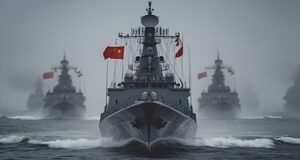
Maybe this is one of those hundred-dimensional chess maneuvers sometimes attributed to President Trump. If you don’t have that blessed power, though, things seem perplexing. If China were to “send Ships,” warships, to the Strait of Hormuz, this dispatching would mean fewer warships available to be deployed elsewhere, like maybe the Taiwan Strait. Is that part of the calculus?
What if China said, “Sure, fine, a hundred warships to help you clear the Strait of Hormuz are on the way.” Then what?
President Trump may be making an empty gesture, one that is not hyper-strategic at all, counting on the fact that China is inclined to help Iran only indirectly.
But what if the Chinese government were on the verge of deciding to get more directly involved in the war? Would the U.S. allow a fleet of PLA warships to head toward Iran and enter the waters near Iran unhindered as long as they announce “We’re from China and we’re here to help”?